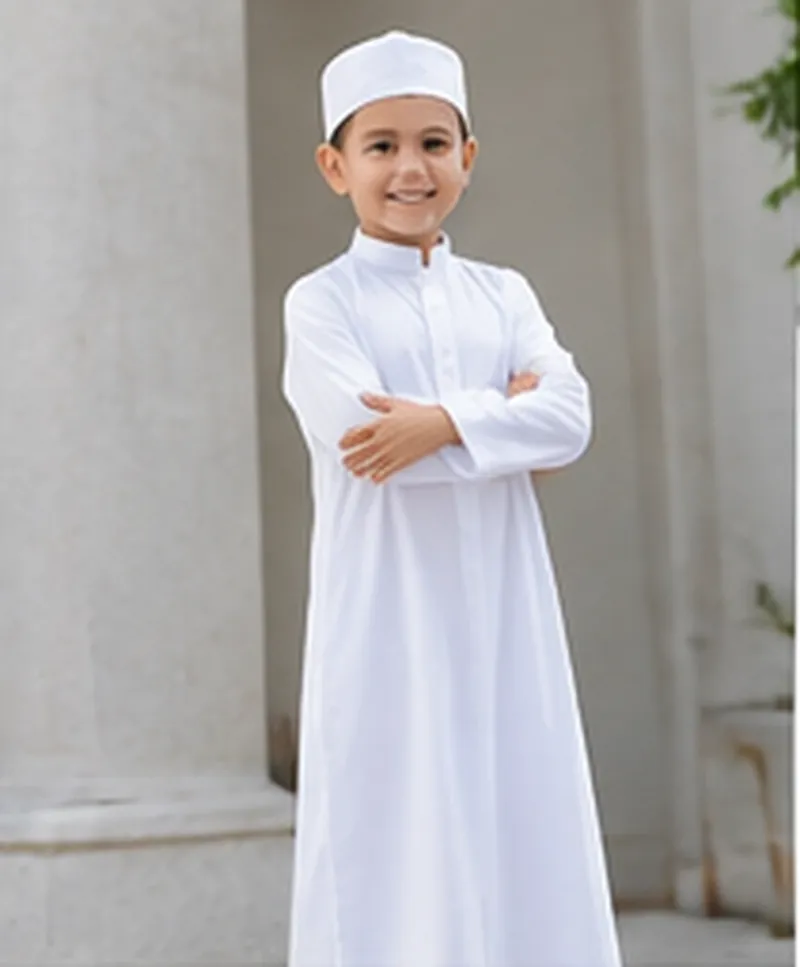
What a mini qamis is
A mini qamis is a very small robe that copies the cut of the garment worn by fathers and grandfathers: a long shirt with sleeves, a short opening at the neck and a hem that reaches the shins or ankles. In babies' sizes the proportions are adapted, with a shorter body, wider armholes and fastenings placed where an adult can reach them while the baby lies on a changing mat.
The Arabic word qamis means shirt, and similar robes are known by other names around the world: thobe in the Gulf, dishdasha in Oman and Iraq, kurta in South Asia, kaftan or gandoura in North Africa. A baby qamis may borrow details from any of them, such as a mandarin collar, embroidered placket or a small chest pocket. Many families enjoy the idea that a son shares something of his father's dress from the earliest weeks.
The outfit is ceremonial rather than everyday in most homes. Babies spend most of their time in bodysuits and sleepsuits, and the mini qamis is worn for photographs, visits to relatives and religious gatherings.
Occasions when babies wear a qamis
The most common occasions are family celebrations. A first Eid, a visit to grandparents, a welcome-home gathering and a naming ceremony are typical moments when parents bring out the robe. Many families also dress a baby in white or cream for a first trip to the mosque, to match the clothes worn by the men around him.
A child's birth celebration, often called aqiqah, is traditionally held around the seventh day after birth in many communities, though timing and customs differ, and the baby is usually dressed in something clean and simple. Some parents choose a mini qamis, others prefer a plain gown. Neither is required; the choice is cultural.
Photographs are a major reason. Families send pictures to relatives abroad, and a small boy in a white robe and cap is a familiar image. Keep the sessions short, because infants tire quickly and a changing bag with spare clothes is a sensible companion.
Fabrics that are gentle on newborn skin
Infant skin is delicate and reacts easily, which makes gentleness the first requirement. Pure cotton, in a fine weave or a gentle jersey, is the best base for a baby qamis. Muslin cotton is airy and suitable for warm climates, while cotton interlock or brushed cotton provides warmth for cool weather. Avoid stiff polyester satin, scratchy lace and coarse embroidery against the neck and chest.
Check the lining of any decorated piece. Embroidery on the front should be backed by soft fabric so threads do not touch the skin. Seams should be flat or placed on the outside, and labels should be printed or sewn in at the side so they do not rub against the neck.
Many parents wash garments before the first wearing. Pre-washed fabric is softer and less likely to shrink later. Use a mild, fragrance-free detergent suitable for babies' clothing, and rinse thoroughly so no residue remains.
Safe mini qamis design: closures, buttons and neck openings
Safety rules for baby clothing are stricter than for older children, and sensible parents check each detail. Small decorative buttons are a choking risk if they come loose; the safest garments use sewn-in snaps, hook-and-loop strips with a covered edge or a shoulder opening with press studs. Long cords and ties should be avoided, since they can wrap around a baby's neck or limbs.
The neck opening should be generous and stretch gently. Envelope shoulders, which overlap and allow the garment to be pulled down over the body instead of over the head, are a useful feature in newborn clothing. For a long robe, a bottom opening is helpful at nappy changes, or a two-piece set with separate trousers.
Inspect the garment before each use for loose threads, detached sequins or beads and worn press studs. Embellishment is attractive, but it should be flat and firmly stitched. If in doubt, leave decoration on the cuffs and hem rather than near the baby's face.
Sizing a mini qamis for a baby who grows quickly
Newborns grow fast, and a mini qamis may fit for only a few weeks. Labels normally list months, yet cuts vary between makers, so rely on the stated weight and length rather than age alone. Choose the size your baby will be on the day of the event, not the day of purchase, and buy a little early to leave time for exchange.
Length is partly a matter of taste and partly of practicality. A robe that reaches the ankle looks traditional but will bunch around a baby who wriggles or crawls. A knee-length qamis with matching trousers is simpler to manage, and the legs stay warm. For a baby who is not yet mobile, a longer gown lets the feet be tucked in.
Make sure the sleeves are comfortable and not too tight at the wrist, and that the waist is loose enough to let the tummy expand after a feed. Run a finger inside the neck and cuffs to check that nothing digs in.
Caps, socks and keeping a baby comfortable
A matching cap completes the look. A small cotton cap or a soft crocheted kufi is the traditional choice, but a hat should always be comfortable and secure. Remove it indoors when the baby is warm, because overheating is a concern. Health services such as the NHS in the United Kingdom advise that babies should not sleep with a hat on and that a hat should come off once indoors.
Temperature management matters more than appearance. Dress the baby in layers so that you can remove one if the room is warm. A cotton vest under the qamis, soft socks or booties and a light blanket for the car seat or pram are enough for most days. In cold weather add a thin cardigan, but remove any thick garment before placing the baby in a car seat harness.
Keep spare clothes close at hand. Spit-up, leaks and sticky fingers are inevitable, and a clean second set avoids a stressful moment during the gathering.
Buying, gifting and caring for the outfit
Mini qamis sets are sold in Islamic clothing shops, baby boutiques and online. Many are sold as gift sets, with a robe, cap and trousers packed together, which makes them popular presents at the birth of a son. When buying a gift, a size slightly larger than newborn avoids disappointment, since the baby may already have outgrown the smallest size by the time the parcel arrives.
Read the care label. Cotton can be machine washed at a moderate temperature, but embroidered or trimmed pieces may need a gentle cycle or hand washing. If the little one has sensitive skin, leave out fabric conditioner, and let the garment dry flat or on a line, away from strong heat. Iron on a low setting, inside out for embroidered garments.
After the baby outgrows the outfit, store it carefully in a breathable bag. Many families keep a first qamis as a memento, and it can be passed to a younger brother or cousin when conditions allow.
Frequently asked questions
At what age can a baby wear a mini qamis?
From birth, provided the fabric is soft, the fastenings are safe and the garment is not tight. Newborn sizes exist, but most parents save the outfit for specific occasions, since daily wear for infants is usually a bodysuit or sleepsuit.
Which fabric is best for a baby qamis?
Pure cotton is the first choice, in muslin for summer or brushed cotton for cooler weather. It is gentle on the skin and easy to wash. Avoid stiff synthetics, rough lace or embroidery that touches the neck or chest.
Is a baby qamis required for aqiqah or the first mosque visit?
No. Any clean, modest and comfortable clothing is suitable. A mini qamis is a cultural preference chosen by some families, and the choice has no religious requirement. Many parents simply like the family resemblance.
How do I know whether the buttons are safe?
Tug each button, snap or bead firmly. It should not move. Prefer sewn-in press studs or covered strips near the baby, and avoid loose decoration. Throw away or repair any garment where small parts begin to come away.