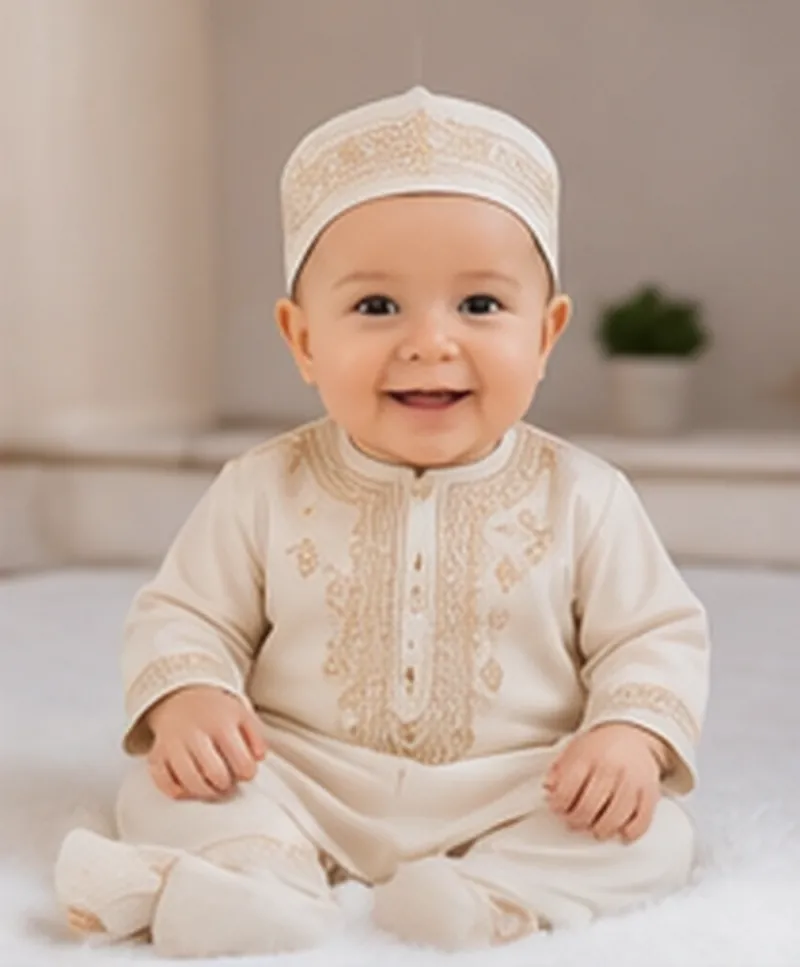
What newborn hats are for
Newborn hats are cut to fit the small, rounded head of a baby in the first weeks, and they serve several purposes. The first is warmth: a baby loses heat easily, and in the first hours after birth a hospital often provides a cotton cap to help the child stay comfortable. The second is protection from sun and wind when the baby goes outside. A third is simply tradition and appearance, since a small cap completes an outfit.
In many Muslim families a baby's first cap is a treasured item. It may be white and embroidered, handed down from relatives, or knitted by a grandmother. The cap can echo the kufi worn by men and boys, a smaller version of the same idea. It is also worn for photographs and ceremonies such as the naming celebration.
A good newborn hat should be easy to put on and take off, and it should not be forced over the ears or the face. It is a comfort item, not a fashion burden.
Why soft cotton is the preferred fabric
Cotton is breathable, absorbs moisture and feels gentle on fragile skin. A cotton jersey cap stretches slightly, which helps it fit different head shapes, while a woven cotton cap holds its shape and suits more formal outfits. Muslin cotton is lightweight and suits warm weather. Interlock cotton gives a smooth finish and a bit more warmth.
Wool and acrylic can be warm but may irritate a newborn, especially when the fibres are coarse. If wool is used, merino is softer than standard wool, and a cotton lining prevents contact with the skin. Synthetic fleece traps heat and may cause the baby to become too warm indoors.
Look at the inside of the hat. Seams should be flat, or sit outside, and the label should be printed or attached away from the forehead. Run a finger along the inner edge to check for rough stitching. A hat that feels uncomfortable to an adult hand will bother a baby more.
Getting the fit right for fragile heads
Newborn head sizes vary, and a cap that fits one baby may swamp another. Take a tape around the baby's head, just over the brows, and read the result against the brand's size guide. Sizes are often labelled newborn, zero to three months and so on, but the actual dimensions differ among brands. A cap with a little stretch is more forgiving.
The cap should sit snugly without leaving a red line. Check the forehead and ears for marks after a few minutes. If the band presses, move up a size. Avoid caps with tight elastic around the face, which can leave impressions on soft skin. Caps that tie under the chin should have a soft, short ribbon, or a hook-and-loop closure that does not scratch.
Remember that the head changes shape and size quickly. A cap that fits at one week may be too tight by six, so keep spares in the next size. Do not force a cap over a head that is still settling after birth.
Safe use: temperature, sleep and indoor wear
Hats help in cold weather, but they can cause overheating if worn in warm rooms. In the United Kingdom the NHS advises that a baby's head should be uncovered when sleeping and that hats should be removed once indoors or in a warm car. Babies cannot easily regulate their temperature, and the head is one of the main places where heat escapes.
Signs of overheating include a flushed face, sweating or damp hair, and fast breathing. If you notice these, remove the hat and a layer of clothing. Feel the chest or back of the neck, which gives a better indication of temperature than the hands or feet, which may feel cool.
Never leave a baby asleep with a hat that could slip over the face. Remove ties and strings before sleep. A simple cap is for waking hours, outings and ceremonies. For particular concerns, speak to a midwife or health visitor.
Traditional baby caps in Muslim cultures
Caps for babies appear in many Muslim communities. In the Arab world, a small white taqiyah may be used for baby boys, while in South Asia a small topi in white or pastel is popular. West African families may use knitted or embroidered kufi-style caps, and in Turkey a baby may wear a small crocheted bonnet with lace. For girls, a bonnet or soft scarf may be used.
These caps are sometimes made by family members as gifts. Knitted or crocheted caps with delicate patterns, embroidery or lace edging are often treasured. They tend to be more fragile than shop-bought jersey caps, so reserve them for occasions and make sure the inside surface is smooth.
Whether a baby wears a cap is a matter of custom, not a requirement. Some families put a cap on a boy for prayers and gatherings only, while others use it as everyday headwear in cold weather. Parents decide according to climate and family habits.
Choosing between pull-on caps, bonnets and beanies
A pull-on cap is the simplest style: a stretchy tube closed at the top, sometimes with a small knot. It suits the hospital and the first weeks, because it slips on quickly. A bonnet ties under the chin and is gentler for babies with large heads or those who dislike pulling over the face. It is more formal and often seen in ceremonies.
A beanie has a turned-up cuff and is a good option for colder weather, as the cuff gives a double layer around the ears. Sun hats with a brim or a flap at the back protect from sun in summer, and a cotton hat with ear coverage suits breezy days. Choose according to the season and the planned activity.
Think about the car seat. Thick hats and padded caps can make straps less secure or push the head forward, so choose a thin cap for journeys and remove the hat when the car is warm.
Washing, storing and replacing hats
Wash cotton hats with the baby's other clothes, using a mild, fragrance-free detergent. Turn embroidered ones inside out. Avoid bleach and fabric softener, which may irritate the skin and weaken the fibres. Dry flat or on a line to prevent shrinking, and re-shape the cap while damp.
Caps pick up milk and dribble, so keep several in rotation. Wash them promptly if they are soiled, and treat stains while fresh. Store them in a drawer away from sunlight, which can yellow white cotton, and keep delicate bonnets in a box with tissue.
Replace a hat as soon as it is too tight, the elastic is worn or the seams begin to fray. Because newborn hats are worn briefly, many families pass them on to cousins or friends, which is a pleasant custom as long as the cap is clean and in good repair.
Frequently asked questions
What material is best for a newborn hat?
Soft cotton, such as jersey, interlock or muslin, is the best choice. It breathes, absorbs moisture and is gentle on skin. Wool or acrylic may irritate unless the cap has a smooth cotton lining.
Should a baby wear a hat indoors?
Only for a short while. Health guidance in the UK, such as that from the NHS, advises removing a hat once indoors and never sleeping with one on, because babies can overheat easily and lose heat mainly through the head.
How do I know a newborn hat fits properly?
The hat should sit snugly without leaving a red mark on the forehead or ears. If the band presses or the cap rides over the eyes, change the size. Check the fit after a few minutes of wear.
Do Muslim babies have to wear caps?
No. Caps are a cultural and practical choice, not a rule for babies. Many families use them for warmth, ceremonies and photographs, and leave them off otherwise. Parents decide according to climate, comfort and family custom.