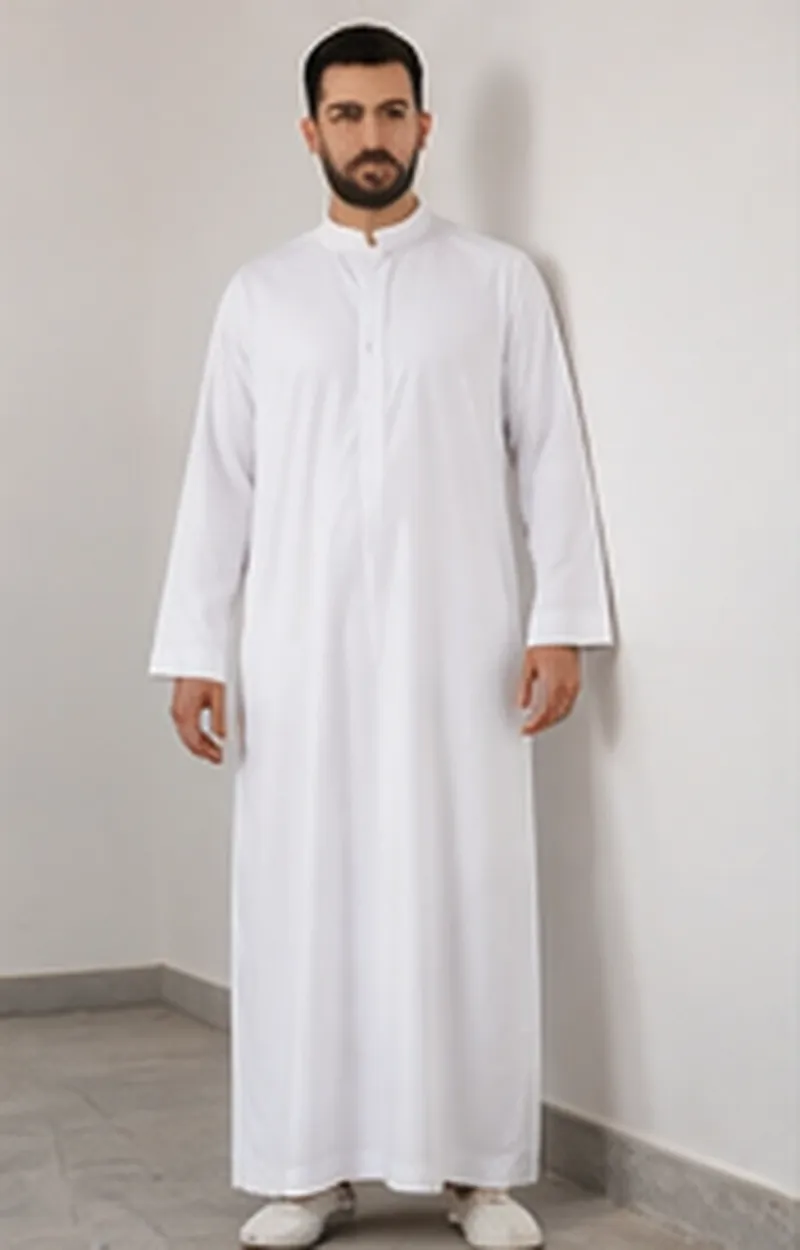
Why a thobe needs the right layer underneath
Lightweight lightweight trousers are cut from thin woven cloth and made to be worn beneath a long robe, where they act as an invisible foundation. A thobe is a loose ankle-length garment, usually of white cotton or similar fabric, and light colours in thin cloth can be translucent in strong sun. A well-chosen layer underneath prevents the outline of the legs from showing and keeps the robe from clinging to the skin.
The second reason is comfort. Between the skin and the robe, a smooth thin layer absorbs perspiration, reduces friction and helps the thobe hang straight. Under strong heat it helps the wearer stay dry, while in colder weather it provides gentle warmth without the bulk of an overcoat.
The third is practicality. A man who sits on the floor, kneels in prayer or climbs into a car appreciates a garment that covers the legs properly if the robe rides up. Trousers under a thobe give that assurance while remaining out of sight.
Fabrics that make lightweight trousers breathe
Cotton is the safest choice, and fine poplin, voile and lawn weaves are very light and smooth. Linen and cotton-linen blends dry quickly and feel cool, though pure linen creases easily and may be visible through a thin robe. Bamboo viscose and modal blends are soft and cool against the skin but can cling in humid weather, so they suit dry heat better.
Polyester blends are sometimes used for durability, and a small proportion of synthetic fibre can reduce wrinkling and speed drying. Look out for fabrics that trap heat or feel sticky, since a layer worn for many hours under a long robe must stay comfortable. Check the label rather than relying on a product name.
For colour, white and cream are standard under a white thobe because they are least likely to shadow through the cloth. Beige, light grey or a skin-tone shade can work under coloured robes. Dark thobe trousers under a pale thobe are best avoided as they show through.
Cuts of trousers under a thobe: straight, drawstring and sirwal
Under-thobe pants come in three common shapes. A straight, simple cut with a flat front feels like thin ordinary trousers and gives good coverage. A drawstring pyjama style has an elastic or cord waist and a roomy leg, and it is easy to adjust. A traditional sirwal-type cut has extra fullness and is gathered at the ankle, which some men like for prayer.
Rise matters. A mid-rise, close to the natural waist, prevents bunching under the robe and holds the layer in place. A very low rise tends to slip, and a very high rise can create a bulge under a fitted thobe. A slightly tapered leg avoids snagging on the hem of the robe.
Choose the width for the thobe above it. A slim-cut robe needs slimmer trousers to avoid ripples, while a voluminous one can hide a roomier pair.
Length, ankles and modest clothing guidance
Most under-thobe trousers are cut to the ankle bone or slightly above it. This keeps them hidden when the robe is long and visible only as a neat edge if it lifts when walking up steps. Some men prefer the hem of the lightweight trousers to be a little shorter than the robe so the lower line is clean.
There is a long-running discussion among scholars about the permissibility of garments hanging below the ankle for men. Views range from discouraging it in general to restricting it to cases of pride. As the matter is disputed, anyone who wants clear guidance on it should ask a qualified scholar. Whatever view one follows, hem length can be adjusted at the ankle with a simple turn-up or a cuff.
From a purely practical angle, an ankle-length hem also prevents the trouser edge from collecting dust when walking, and it avoids rubbing against shoes.
Details that improve thobe trousers
Pockets are optional but handy. Deep side pockets sewn flat are discreet, and some robes have slits that allow access to the pockets of the trousers underneath. Choose pockets that do not create a visible bulge, and avoid cargo-style flaps that add thickness.
Think also about how the garment behaves during a long day. Trousers that are slightly loose at the knee make sitting on the floor easier, while a firm but soft waistband keeps everything in place when you stand up quickly. If you travel often, pick a fabric that dries overnight and needs little ironing, because the layer will be washed more often than the robe itself.
Waist fastenings should be flat. Elastic with a drawstring is the most forgiving, while a button front gives a more tailored feel. A soft waistband matters when sitting for hours, as in a long gathering, a flight or a day at work.
- Seams: flat-felled or overlocked seams avoid chafing against the thigh.
- Lining: a thin cotton lining adds opacity without adding noticeable heat.
- Gusset: a diamond-shaped panel at the crotch makes movement easier when kneeling.
- Ankle: a narrow hem or a soft cuff keeps the trouser from riding up.
Matching with undershirts and underlayers
Trousers are only one part of the layering system. Under a thobe many men also wear a plain undershirt, called a fanila in parts of the Gulf, which protects the robe from sweat marks and adds opacity at the chest. A matching undershirt and trouser in the same tone gives a uniform base that avoids visible lines.
In winter, a thin thermal layer can be added without changing the silhouette of the robe, and a long-sleeved undershirt keeps the arms warm. In summer, a sleeveless cotton vest is enough.
Take care with colours and prints. A patterned trouser may show through a pale robe, so keep to plain shades. Socks should match the thobe trousers to avoid a visible contrast at the ankle.
Buying and caring for under-thobe pants
Before buying, lift the cloth up to a lamp or window and look at what shows through: a hand that is plainly visible behind one layer means the fabric adds very little cover. Try the lightweight trousers on with the thobe you plan to wear, sitting, bending and walking. Pay attention to how they feel after an hour, not just in the shop.
Follow the care label when washing. Cotton and linen blends can usually go in a warm machine wash and are best dried in the shade. Iron on a medium heat while the fabric is slightly damp. Because the thobe trousers are in contact with the skin, wash them often and avoid heavy fabric softeners that can leave a film and reduce breathability.
Buy several pairs of the same type if you wear a thobe most days. Rotating them extends their life, and having a spare pair is useful for travel, Friday prayers and gatherings.
Frequently asked questions
Do I need trousers under a thobe?
It is not compulsory, but many men wear them for opacity, comfort and coverage when sitting or kneeling. Thin white robes can be translucent in bright light, so a light layer beneath is a practical precaution.
What colour should the layer be under a white thobe?
White or cream is safest because it blends into the fabric and does not show through. Beige or a skin-tone shade can also work. Dark colours should be avoided under pale robes as they create visible shadows.
How long should the trousers be?
Most are cut to the ankle bone or slightly above. Scholars differ on garments hanging below the ankle, so many men choose to keep the hem at or above it. A qualified scholar can advise on the details.
Which fabric is coolest in summer?
Fine cotton, voile and cotton-linen blends are the coolest. They breathe and dry fast. Avoid thick synthetic fabrics that trap heat, and choose a weave dense enough to remain opaque under a thin robe.