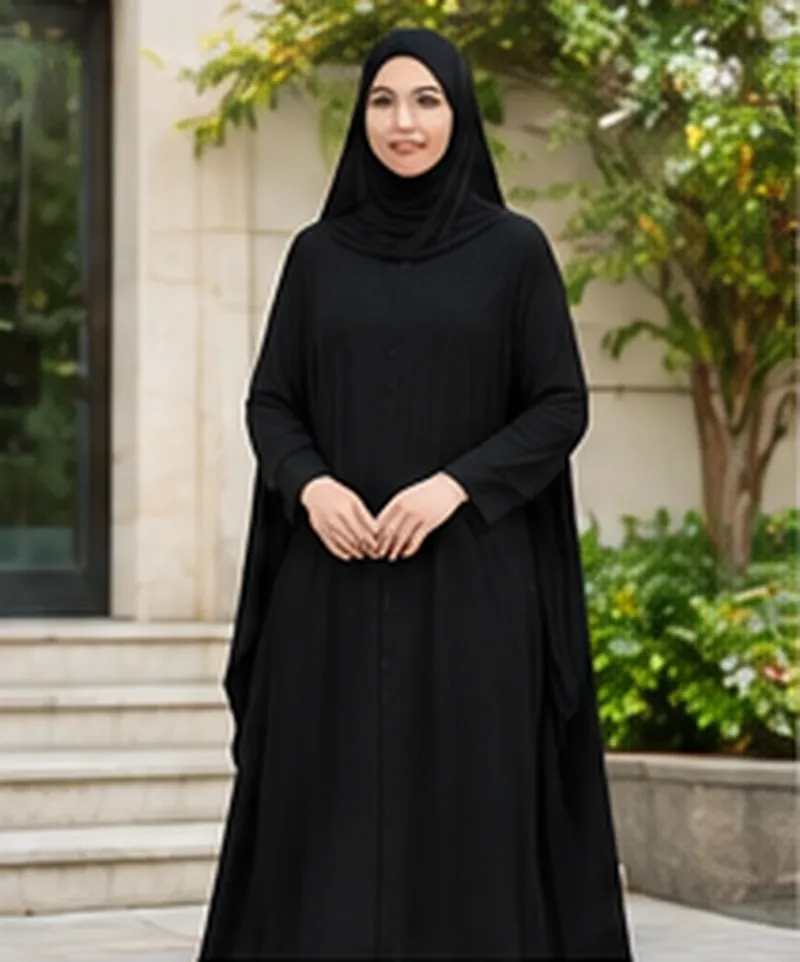
What Islamic clothing for women includes
Islamic clothing for women is a wide category covering the pieces worn on the body, the head and the feet. It begins with outer robes such as the abaya, which hangs from the shoulders, and the jilbab, a longer coat-like garment, and extends to long dresses, shirt dresses, tunics, pleated skirts and wide-leg trousers.
Women make different choices within this range. Some wear a full-length robe and face veil, others a long skirt, loose shirt and a scarf, and others adopt only part of the practice. Communities, families and individuals interpret the guidance on covering in more than one way, so the wardrobe of one woman can look quite unlike another's.
What most share is a preference for loose shapes, opaque cloth and sleeves and hems that stay in place during normal movement. That shared preference is why Islamic clothing for women can look so varied from one city to another.
The abaya and other outer layers
The abaya is the best-known outer layer. In the Gulf it is often black, cut straight or slightly flared, and worn open or closed over everyday clothes. Elsewhere it appears in navy, taupe, olive or deep burgundy, with embroidered cuffs, bell sleeves or subtle pleats at the back. Cuts vary from slim to wide, so try several before settling.
Coats and kimonos offer a lighter alternative. A long open cardigan, a duster coat or a belted trench provides coverage in cooler climates without the formality of a robe, and many women find them easier for school runs, commuting and shopping. Such layers are among the most useful women's modest wear pieces for a changeable climate.
The jilbab in some countries is a single-piece garment that falls from shoulder to ankle with attached sleeves. It is practical for those who want quick, complete coverage, and styles range from simple cotton to heavy wool.
Modest clothing for Muslim women built from tunics, skirts and trousers
A great deal of modest clothing for Muslim women is assembled from ordinary separates. A long tunic reaching mid-thigh or below sits well over straight trousers, and a pleated midi or maxi skirt pairs with a loose blouse that covers the hips.
To keep outfits coherent, repeat a colour: a dusty rose scarf with a cream tunic and a rose-toned cardigan, for example. Neutrals as a base, with a single brighter piece, give variety without constant shopping.
- Tunic with wide-leg trousers for work or study
- Maxi skirt with a layered long top for relaxed days
- Shirt dress with a belt for a smarter look
- Jersey dress under a light coat for travel
Pockets, secure necklines and a sensible length make everyday wear easier; a tunic that rides up when you climb stairs or bend to lift a child is rarely worth keeping.
Fabrics, colours and prints in women's modest wear
Cloth choice can make the same cut feel entirely different. Crepe and satin-backed fabrics fall in clean lines for formal wear. Cotton voile and linen breathe in summer. Knitted jersey is stretchy and forgiving for everyday life, and wool blends keep warmth in cold seasons.
Colour is a personal and cultural matter. Black remains widely worn, particularly in the Gulf, though many women favour earth tones, pastels or bright shades. Prints such as small florals, geometric patterns and tone-on-tone embroidery are common, whereas very bold or attention-seeking designs are avoided by some.
Always test opacity in daylight, especially with pale fabrics, and consider a slip or lining. Seams across the hip and chest can also reveal shape if the cloth clings.
Headwear and finishing touches
Many women wear a hijab as part of their dress, selecting from square scarves, long rectangular shawls, jersey wraps and ready-to-wear styles with a sewn-in cap. The choice depends on climate, activity and the way a wearer prefers to drape the cloth. These choices are as much part of modest clothing for Muslim women as the robe itself.
Accessories complete the effect. A fine brooch or magnetic pin secures the scarf, a leather belt defines a loose robe, and a structured bag adds polish. Shoes and tights should be comfortable for walking, and socks are often added with sandals by those who choose to cover the feet.
Jewellery is kept simple by many, with a watch, small earrings or a ring. Fragrance, makeup and nail care are matters on which opinions vary widely, and each woman decides according to her own understanding. Muslim women's clothing accessories are best chosen to match the main outfit instead of competing with it.
Regional styles worth knowing
Regional dress adds variety to any wardrobe. The Moroccan kaftan and djellaba, Pakistan's shalwar kameez, the Malay baju kurung, Turkey's pardesu coat and the Somali dirac all mirror regional weather and taste. A woman living far from her family's homeland often keeps a few of these garments for special occasions.
Modern designers blend such traditions with contemporary cuts. An embroidered yoke from one country may appear on a minimalist tunic made elsewhere, and a batik print can be used on a streamlined shirt dress.
Learning the names of these garments helps in shops and online, where search terms vary. A shopper who knows the difference between a kaftan and a khimar will find the right item faster and avoid ordering by guesswork.
Mixing regional pieces with everyday separates is common, and it keeps the wardrobe personal rather than uniform.
Dressing for work, prayer and celebrations
In the workplace, modest outfits often take the form of tailored trousers, a long blazer and a plain scarf, or a shirt dress with sleeves to the wrist. Uniform requirements in healthcare, education and hospitality may influence the choice, and many employers can accommodate reasonable adjustments. Islamic clothing for women in these settings tends to be understated.
For prayer, comfort and coverage come first. Many women own a prayer set, a two-piece garment with a built-in head covering, or simply pair a big scarf with a long skirt. Clothing should allow bowing and prostration without shifting or exposing the body.
Weddings, Eid gatherings and family visits invite richer cloth, embroidery, sequins or lace details. The silhouettes often stay the same as everyday dress, only in more festive colours and decoration.
Choosing well: fit, comfort and personal convictions
A good fit is loose without drowning the wearer. Shoulder seams should sit at the shoulder, sleeves should reach the wrist or just beyond, and the hem should clear the ground enough to prevent tripping on steps. In practice, the best Islamic clothing for women is the clothing worn comfortably every day.
Before buying, walk, sit and reach in the fitting room. If a garment gapes, rides up or restricts movement, it will stay in the wardrobe regardless of price.
Questions of religious detail, such as which parts of the body to cover in particular settings or how to treat a particular fabric, are answered differently by different schools and scholars. Speak to a qualified teacher you trust where you need guidance, and dress in the manner your conscience supports. Choosing Islamic clothing for women is ultimately a personal decision.
Frequently asked questions
What is the difference between an abaya and a jilbab?
An abaya is usually a loose robe worn open or closed over clothes, while a jilbab often means a longer, more enclosing garment with fitted sleeves. Terms vary by region, so check the description and measurements of each item.
Can women wear ordinary shop-bought clothes and still dress modestly?
Yes. Many pair wide trousers, long skirts, loose shirts and long cardigans from regular stores with a scarf. What matters is non-transparent fabric, a relaxed cut and the level of coverage that fits the wearer's own view of modesty.
Which colours are acceptable?
There is no single rule. Black is common in some regions, but many women wear earth tones, pastels and brighter shades. Opinions about conspicuous colours differ among communities, so follow your own convictions and the guidance of a trusted teacher.
How do I make sure a garment is opaque?
Hold the fabric against a window, put your hand behind it and look for shadows. Try it on in bright light, sit, stretch and bend. If the cloth thins at stress points, wear a lining or choose a heavier weave.