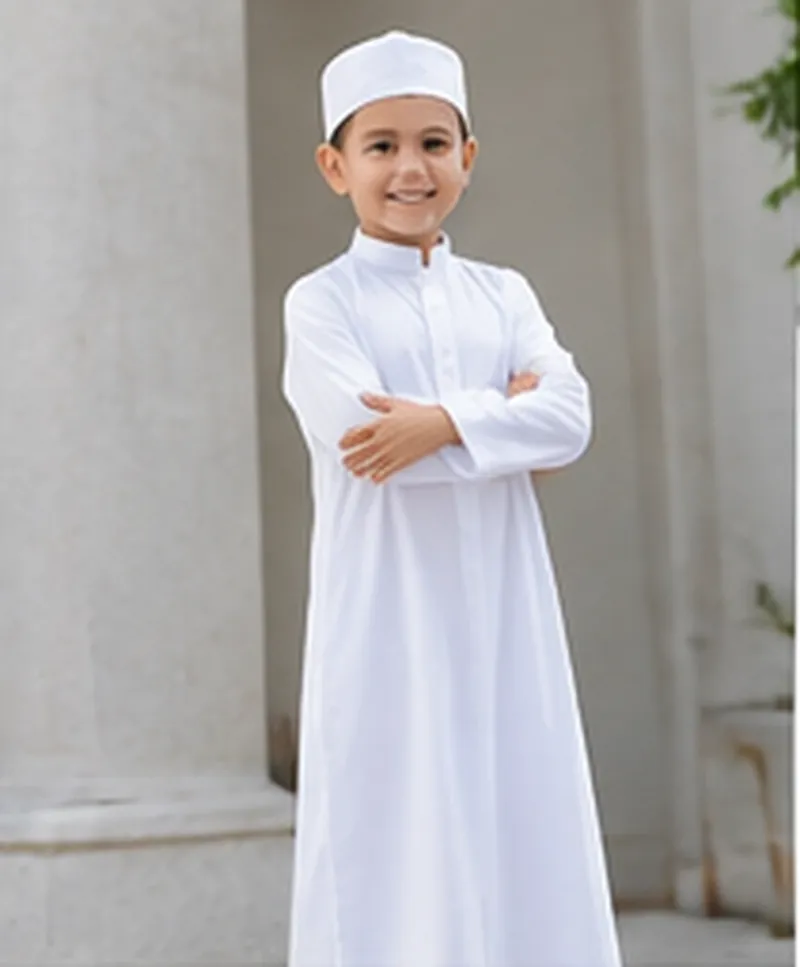
What Islamic clothing for boys includes
Islamic clothing for boys covers the outfits Muslim families choose for their sons, from everyday shirts and trousers to the thobe, the kurta and the prayer cap. It is a flexible idea, not a uniform. Boys usually wear the same jeans, hoodies and trainers as their classmates, then switch to traditional clothing for the mosque and celebrations. Halal clothing for boys is mostly about comfort and respect.
Religious teaching for boys on covering is generally understood to apply as they approach puberty, and families introduce modest habits gradually. Many parents start by offering a thobe for Friday prayers or Eid, so that the garment is associated with happy, special days rather than obligation.
Comfort, durability and ease of movement are the main concerns for young children, and the best outfits let boys run, climb and kneel without fuss.
Regional habits add colour. A boy in Pakistan may wear a small shalwar kameez, in Morocco a child's djellaba, in the Gulf a kandura and in Indonesia a koko shirt with a sarong. Islamic clothing for boys therefore stretches across many cultures, which is why shops stock such a varied selection.
Halal clothing for boys across the ages
For toddlers, soft cotton shirts, loose trousers and small thobes with simple buttons or snap fastenings work well. Avoid long dangling cords and fiddly collars that irritate. Babies often wear sleepsuits and bodysuits, with a cotton hat for sun.
For primary-school boys, relaxed trousers, long-sleeved shirts and tunics in hardwearing fabrics are the core of the wardrobe. A kurta or short thobe for Friday prayers can be worn over trousers, and boys at this age often enjoy matching their fathers.
For teenagers, adult cuts become relevant. Straight trousers, longline shirts, coats and a full-length thobe are available in youth sizes, and many teenage boys express their identity through caps, shoes and accessories.
Shoes deserve a thought. Slip-on sandals or easy-lace trainers help at the mosque entrance, and sturdy soles protect against playground knocks. Socks in cotton blends stay comfortable through long days.
Boys' thobes, kurtas and festive outfits
Boys' thobes are scaled-down versions of men's garments, usually in cotton or poly-cotton, with mandarin collars and hidden buttons. White is traditional for Eid, though cream, grey, navy and brown versions appear too, and some come with a matching waistcoat. These boys' thobes are widely sold in specialist shops.
Kurtas from South Asia are tunics worn over trousers or pyjama bottoms. For celebrations, they come with embroidery at the collar, contrast piping and waistcoats, and for younger boys elastic waists keep things simple.
In West Africa a miniature boubou or agbada, and in Southeast Asia a baju Melayu with a songkok cap, ties boys to family heritage. Matching father and son outfits make Eid photographs memorable.
When buying for the whole family, check that the boys' thobes match the adult size chart proportions. Fathers and sons appreciate coordinated colours, and tailors can adjust sleeves so that a garment lasts another season.
Caps, scarves and small accessories
A prayer cap, called a kufi, taqiyah or peci in different regions, is a popular accessory. Boys may wear one on Fridays, during prayer or on festive days. Knitted, woven and embroidered versions come in many colours, and a snug fit stops it falling during prostration.
Cold-weather accessories matter too. A woollen hat, scarf and gloves help in winter, and a sun hat protects in summer. Choose plain designs that suit both mosque and playground.
- Prayer cap for Fridays and Eid
- Waistcoat for festive outfits
- Belt or sash for traditional garments
- Comfortable shoes that slip off easily
Keep a spare cap in the car or school bag. Caps are easily lost at gatherings, and a replacement avoids tears on Eid morning.
School, sport and swimming for Muslim boys
School uniform policies determine daily dress, and most schools do not conflict with Muslim dress for boys. Parents who want longer sports shorts or leggings under shorts can ask the school politely, and equality bodies in each country explain what is reasonable.
For physical education, loose tracksuit trousers or knee-length shorts, with a breathable top, are enough. Football kit with long socks and optional leggings under shorts keeps legs covered, and clubs usually accept this.
For swimming, longer swim shorts or swim trousers are available in boys' sizes, and a rash top adds sun protection. Ask instructors in advance, and remind the child to rinse the kit after each lesson.
Parents should also pack practical items: a change of clothes for messy play, a clean pair of socks for the mosque and a lightweight coat for outdoor events. Modest boys' outfits work best when they are ready for the unexpected.
Fabrics, fit and care for growing boys
Boys wear out knees and elbows quickly. Reinforced trousers, double-stitched seams and mid-weight cotton last longer than thin fabrics. Dark or patterned clothes hide stains from play.
White thobes show every mark, so many families buy a second, cream or grey one for daily use and keep white for special occasions. Treat stains quickly and wash separately in cool water.
Buy slightly large and adjust. Hems can be taken up, sleeves rolled and trousers with adjustable waists extended, but avoid very oversized garments that hinder running.
Ironing is rarely needed for everyday cotton, but festive garments look best when pressed. Hang boys' thobes on child-size hangers to avoid creases, and store caps flat in a drawer.
Teaching habits around dress and prayer
Children copy what they see, so fathers, uncles and older brothers who dress with care provide the strongest example. Let boys help choose their thobe or cap, and explain why the family wears certain clothes on special days.
Keep prayer clothing separate and clean. Keeping a loose outfit and a cap by the front door makes Friday prayers easy to prepare for, and older boys benefit from a compact prayer mat in the school bag. Islamic clothing for boys is learned through example more than lectures.
Questions about religious detail, such as the correct length of garments, are answered differently by different scholars. Ask a trusted, qualified teacher, and let the boys put their own questions too.
Buying well and keeping costs sensible
Boys grow fast, so think about cost per wear. A single good Eid thobe may be worn only a few times before it is outgrown, so consider hand-me-downs, family swaps or second-hand shops for formal pieces. Islamic clothing for boys need not be costly.
Plain basics work best for daily life: a few long-sleeved shirts, loose trousers, a hoodie and a coat. Buy festive pieces in the months before Eid, when more choice is available.
Shop online with care. Compare height and chest measurements against the size chart, check the fabric and read the returns policy, because sizing for children varies considerably between makers.
Finally, set aside a box for outgrown garments. Passing them to cousins or neighbours means boys' thobes in good condition find another wearer, which suits both budgets and the environment.
Frequently asked questions
At what age should boys start wearing a thobe?
There is no set age. Many families introduce a thobe or kurta for Friday prayers and Eid from early childhood, simply as a special outfit. The religious expectations for dress generally become more relevant around puberty. A qualified scholar can advise your family.
What do boys wear to school?
Boys normally follow the school uniform or dress code, wearing shirts and trousers like everyone else. Longer sports shorts or leggings underneath can be requested politely in advance. Traditional clothes are usually kept for the mosque and special days.
How do I choose the right size for a thobe?
Measure your son from the shoulder to the point where you want the hem, plus chest width, and compare with the size chart. Buy a little large to allow growth, but make sure the garment does not trip him when running.
Which fabrics are easiest to keep clean?
Mid-weight cotton and poly-cotton blends in darker or patterned shades are practical for daily wear. White thobes are best saved for special occasions or washed promptly after any stain, using cool water and gentle detergent.