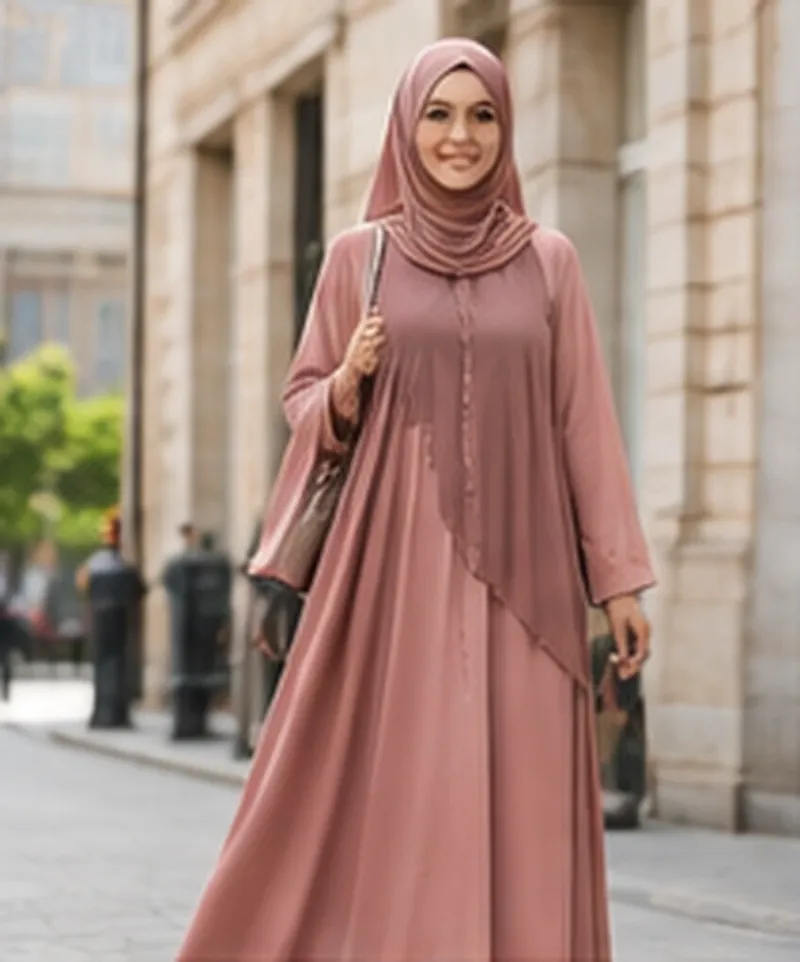
Ceremonial kaftan dresses and where they come from
A kaftan is a long tunic or gown with a straight, loosely fitted body, wide sleeves and an opening at the front. Versions of it have been worn for centuries across the Ottoman world, Persia, the Arabian Peninsula and the Maghreb. Court kaftan gowns in Istanbul were made in rich silk and brocade, while kaftans in Morocco developed their own tradition of fine tailoring and handmade trim.
Ceremonial kaftan dresses are the formal end of that range. They are chosen for occasions in which dress is part of the ritual: a henna evening, a wedding, a naming ceremony, the first day of Eid. Embroidered kaftans and other traditional kaftans can carry whole family histories in their trims. Their fabrics, colours and decoration are meant to be remembered, which is why they are often kept in the family for years.
Regional silhouettes of traditional kaftans
Moroccan kaftans are usually worn with a belt, called a mdamma or hizam, which can be a rigid ornamented band or a soft sash. The cut is long and straight with deep side slits or a closed front, and the sleeves can be narrow or wide. A two-layer set, the takchita, builds on the same idea and is treated on its own page.
Ottoman kaftans were more like open robes with a central front opening, often worn over a shirt and trousers. In the Gulf, a kaftan may be a lighter, loose dress in chiffon or crepe worn for gatherings at home, with beaded neckline panels. Tunisian and Algerian traditions offer related robes with their own collars and embroideries.
Each tradition has its own names for cuts and colours, so when buying a traditional kaftan from a tailor or a boutique it helps to describe the occasion and the region you have in mind. Photographs of kaftan gowns you admire are a good way to show the neckline, the sleeve and the amount of decoration you prefer.
Fabrics for a festive kaftan
For any festive kaftan, satin, velvet, brocade, jacquard, crepe and chiffon are favoured for ceremonial wear because they hold decoration well and look rich under evening light. Velvet kaftans are traditional for cool-season weddings, and light crepes or silk blends suit warm-weather celebrations.
- Velvet: warm and luxurious; best for winter ceremonies and for heavy gold thread.
- Satin and silk blends: fluid and shiny; check the lining and the opacity.
- Brocade and jacquard: woven patterns that already carry decoration, good for simpler cuts.
- Crepe and chiffon: light, flowing and comfortable for long evenings and warm rooms.
Because these are special garments, check the lining carefully. A soft inner layer prevents the outer fabric from clinging, protects delicate embroidery and makes the dress comfortable over a long day.
Weight is worth thinking about. A festive kaftan in brocade can weigh far more than it looks, and a long evening in a heavy gown tires the shoulders. Try the dress on and move your arms before committing, and ask whether the weight sits on the shoulders or is carried by a belt.
Braid and beadwork on embroidered kaftans
Decoration is the signature of a ceremonial kaftan. In the Moroccan tradition, sfifa is a flat braided trim sewn along the front opening and sleeves, and aakad are small knotted buttons made from the same cord. Hand embroidery can be done in gold or silver thread, silk, or beads, with patterns such as arabesques, floral scrolls and geometric lattices.
In Turkish and Persian styles, floral motifs and stylised cypress shapes are common. Gulf kaftans use beadwork, sequins and metallic ribbon along the neckline and cuffs. Cheaper pieces use machine embroidery or printed borders, while hand-made work takes much longer and shows in small irregularities that collectors value.
A useful test is to turn the garment inside out. Neat, secure thread ends and a soft backing suggest careful work, while loose threads and rough patches may snag against skin or hair.
Colour of thread carries meaning in many families. Gold is the most traditional on dark velvet, silver on blue or grey, and silk in the same shade for a quiet tone-on-tone effect that suits women who prefer discreet embroidered kaftans.
Cut, coverage and comfort
A well-cut festive kaftan hangs from the shoulders and moves around the body. Loose sleeves, a high or modest neckline and an ankle-length hem make it a natural choice for women who dress modestly for formal gatherings. Where a design has a plunging front, side slits or sheer sleeves, an inner dress or a long-sleeved underlayer can be added.
Comfort matters during long ceremonies. Choose a belt that does not constrict when you sit, check that the slits do not open too high, and make sure the sleeves allow you to raise your arms and make prayer movements. For a pregnant guest, an empire-waist kaftan keeps room at the middle.
Modest coverage is easily added: a plain long-sleeved inner dress under a short-sleeved gown, a neck piece under a V-neck, and a loose belt that sits at the hip rather than the waist all change the fit without altering the character of the dress.
Choosing a kaftan for the occasion
For a wedding as a guest in traditional kaftans, pick a colour that does not compete with the bride, leaving white and ivory aside unless the family says otherwise. For a henna night, deeper greens, reds and golds are traditional in many places. For Eid, jewel tones or pastels in lighter fabrics fit the daytime visits.
Think about the event's setting. A kaftan with a long train will be elegant in a hall but difficult in a garden. Heavy embroidery can feel stiff in a hot room. If you are travelling to the ceremony, choose a fabric that withstands folding and steaming.
Accessories should support, not compete. A plain headscarf in a tone from the embroidery, simple earrings and a clutch bag are usually enough when the dress itself carries the decoration.
Family expectations are part of the decision. In many households the elders will comment on what is suitable, and consulting a mother or aunt before ordering can avoid disagreements about colour or neckline.
Buying, hiring and tailoring
Many women commission kaftans from a seamstress or a couturier who takes measurements and sketches the design. Others buy ready-made pieces in markets and boutiques, or hire them for a single event. Whatever the route, ask to see samples of the fabric and the trim, and agree on fittings.
Order early. Hand embroidery and braidwork take time, and festival seasons keep tailors busy. When buying online, compare the measurement chart with your own and look for photographs that show the back, the sleeves and the lining.
If you are buying for a younger relative who may grow, ask about extra seam allowance so the dress can be let out.
Caring for a decorated kaftan
Most heavily decorated kaftans are best dry cleaned by a specialist who knows metallic thread and braid. Hang them on padded hangers, covered in breathable cotton, away from direct sunlight. Do not store them in plastic for long periods, which traps moisture and tarnishes metallic threads.
For short-term freshening of kaftan gowns, use a steamer from a distance and avoid pressing embroidered areas directly. Place tissue paper in the sleeves and folds when storing to avoid creases. Heirloom pieces should be unfolded and refolded along different lines now and then to prevent permanent creasing.
Frequently asked questions
How does a takchita differ from a kaftan?
A kaftan is a single gown, while a takchita, in Moroccan tradition, is a two-piece outfit with an underdress and a lighter outer layer. Both are worn for ceremonies and share similar trims.
Which colours suit a wedding guest?
Rich jewel tones, deep greens, golds and soft pastels are common. Many families prefer guests to avoid bridal white or ivory, but customs vary, so check local expectations. Asking the bride's family beforehand is the safest way to avoid an awkward clash.
How can I tell if embroidery is hand-made?
Look at the reverse side and at the stitches. Hand work shows small variations and tidy thread ends, while machine work is perfectly regular and often backed with stiff interfacing.
Can a ceremonial kaftan be worn more than once?
Yes, and families often pass them on. Change the belt, scarf and jewellery to alter the look, and have the garment professionally cleaned and stored properly between occasions. A simple lining and a fresh steaming bring the shine back.