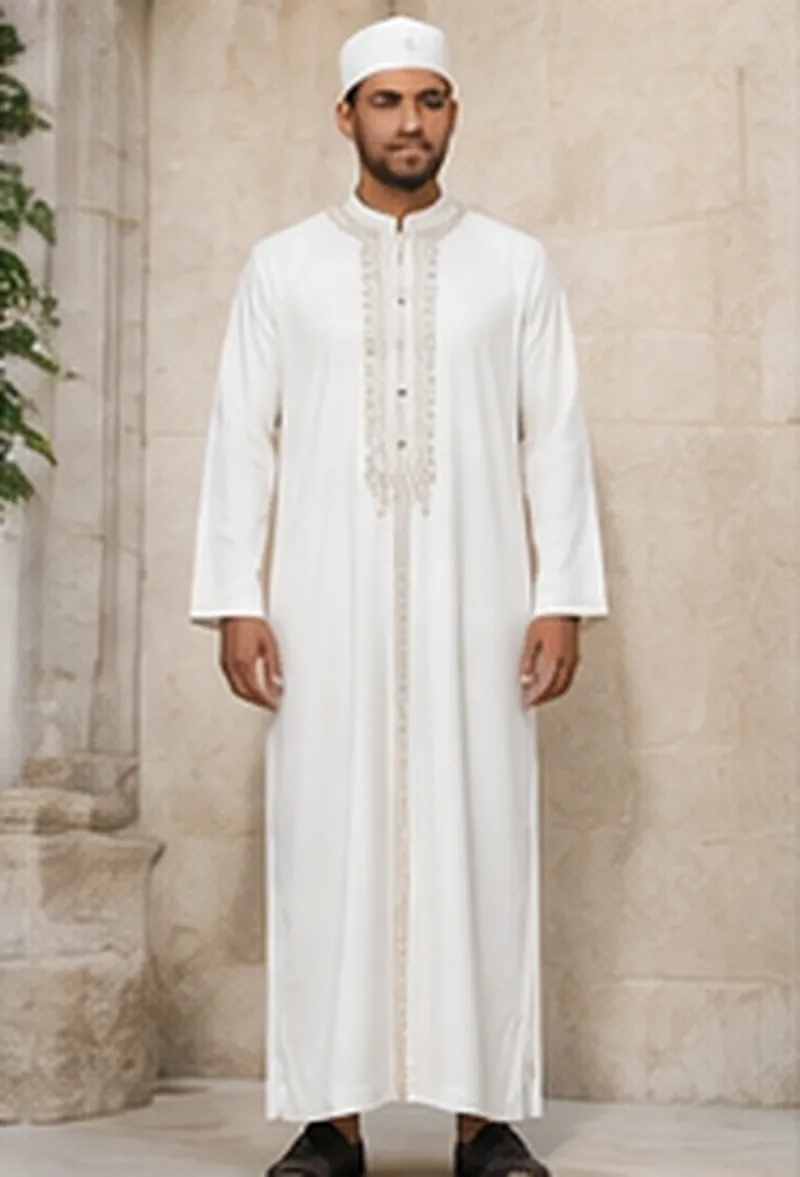
Kanzu robes and the Swahili coast
On the Swahili coast, a kanzu is the long robe that men wear to the mosque, to weddings and to important family events. The word has the same root as the Arabic qamis and reflects the centuries of contact between East Africa, Arabia and the wider Indian Ocean world. Ports such as Zanzibar, Mombasa and Lamu were centres of that exchange, and their tailors developed a clean, elegant version of the robe.
A classic kanzu is white, ankle-length and long-sleeved, with a narrow collar or a rounded neckline and a short placket. Despite its simplicity, this long white robe carries a great deal of meaning: it signals respect, religious observance and belonging to a community that values modest, graceful dress.
Cut and embroidery of the East African kanzu
The body of the robe is cut straight with generous width, and the sleeves are wide enough to move freely. Many Swahili kanzus feature hand or machine embroidery at the neckline and sometimes down the placket and cuffs. Patterns are typically floral or geometric, in white thread on white cloth for a subtle finish, or in gold and silver for ceremonial garments.
A shaped yoke, the panel at the shoulders, gives some robes a refined look, while a pocket at the chest holds a handkerchief or a prayer rosary. Side slits at the hem help with walking and sitting. Quality tailors finish the inside seams neatly so the robe lies flat and does not twist.
Because embroidery is often done by specialist craftspeople, the price of a robe can vary widely, and buyers often visit the tailor in person to choose the design.
Kofia caps and other companions
The kanzu is usually worn with a kofia, a brimless cap. On the Swahili coast, kofia are often embroidered by hand in white or coloured thread and are an art form in their own right. Zanzibar and Lamu are known for fine examples, and each design can indicate a locale or a maker.
In many communities a waistcoat or a jacket is added over the robe, especially for Friday prayer and weddings. In Uganda, among the Baganda, the robe worn under a tailored jacket is a form of formal men's dress for traditional ceremonies. Sandals or leather shoes complete the look, and in some areas prayer beads or a walking stick add a distinguished note.
For colder or rainy days, a shawl or a light blanket is draped over the shoulders.
Young men who are new to the cap often practise at home. A kofia should sit level on the head, neither pushed back like a halo nor pulled down to the brow, and a well-chosen colour can match the thread of the neckline for a coordinated look.
Cotton, voile and the white of the robe
Cotton is the traditional fabric, valued for its breathability on the humid coast. Cotton voile and fine broadcloth offer smooth surfaces suitable for embroidery. Synthetic blends are common for easy care, though they can feel warm. Linen is sometimes used for a more relaxed version.
- White: the classic colour for Friday, Eid and formal events.
- Cream and ivory: softer, kinder to the skin tone, and less glaring in strong sun.
- Pastel shades: increasingly popular for weddings and family gatherings.
- Darker tones: used for everyday wear or in cooler highland areas.
A white kanzu needs good opacity. Thin cloth may show the outline of what is worn underneath, so a medium weight or a lining is wise.
When and where the kanzu is worn
On the coast, it is the garment of Friday, of Eid and of weddings, and many older men wear it daily. At a wedding, the groom may wear a kanzu with an embroidered cap and a decorated jacket, and male relatives often wear matching robes.
In the inland Great Lakes region, the garment follows local customs. In some communities it is associated with religious figures, in others with cultural ceremonies, and in others with modern professional dress during national celebrations. Because the garment crosses religious boundaries in some places, it is worth asking locally what is customary.
For visitors, wearing a Swahili robe to a coastal mosque or wedding is usually welcome when worn respectfully, though advice from a local friend about colour and accessories is helpful.
Children are often dressed in a small version of the robe for Eid mornings, and photographs of fathers and sons in matching white are a treasured part of many family albums on the coast.
Kanzu compared with other men's robes
This robe is closely related to the Gulf thobe, but the East African version tends to be softer in its lines, with more embroidery near the neckline and a lighter weight. It is also different from the South Asian kurta, which is shorter, and from the West African boubou, which is much wider with large sleeves.
Within East Africa, regional differences exist. Swahili communities favour embroidery and white shades, Ugandan styles often pair with jackets, and in highland areas darker or thicker fabrics are common. These variations show that the kanzu is a living garment, not a fixed uniform.
Another way to see the difference is by occasion. The Gulf thobe is often a daily work garment, the South Asian kurta moves between casual and formal, and the East African version is reserved more strongly for Friday, Eid, weddings and ceremonies.
Length, fit and religious practice
The kanzu usually reaches the ankle, though some men prefer it slightly shorter for walking and for prayer. The loose cut permits bowing and prostration without restriction. A collar that is too tight can irritate, so tailors leave a little extra room at the neck.
Opinions among scholars about the appropriate length of men's garments differ, and local custom shapes what people consider normal. Those who need a definite answer for their personal case can consult a knowledgeable teacher nearby. The garment itself is flexible enough to be adjusted to different views through length alone.
Fit across the shoulders is the first point to check. If seams sit beyond the shoulder bone, the weight of the robe pulls the neckline backwards and creates an uncomfortable collar, particularly during long prayers.
Buying and caring for a kanzu
Tailors in coastal towns will make a kanzu to measure within a few days. Bring a robe that fits well, or let them measure the shoulders, chest, sleeve and length. Ask about embroidery, collar style and buttons before cutting. Ready-made robes are also sold in markets and online, usually in standard sizes.
A white kanzu stays bright when it is laundered on its own in cool or lukewarm water, kept away from strong bleach, and dried out of direct sun. Iron it while slightly damp, using a cloth over embroidery. Hang it on a wide hanger and store it away from damp, which causes mould and yellowing.
Fabric softener is best avoided on embroidery, as it can leave marks on white thread. Keep a spare set of buttons and a small amount of matching thread in case of a loose placket before an important day.
Frequently asked questions
What is a kanzu?
A kanzu is a long, loose robe worn by men in East Africa, particularly on the Swahili coast, often white and embroidered at the neckline. It is worn for prayer, weddings and festive days.
What is worn on the head with a kanzu?
Usually a kofia, a brimless embroidered cap. Some men wear a plain white cap or a turban instead, depending on region and occasion. A scarf or a plain turban may be added on formal occasions, and the embroidered cap is often a family gift.
Is a kanzu only worn by Muslims?
It is strongly associated with Muslim communities on the coast, but in some inland areas it is also part of wider cultural dress. Local customs differ, so ask what is usual.
How can I keep a white kanzu bright?
Wash it separately, avoid harsh bleach, dry it in shade and store it dry. Pretreat stains early and iron while slightly damp to restore crispness. Hanging it in fresh air after wearing keeps the cotton sweet without washing it too often.