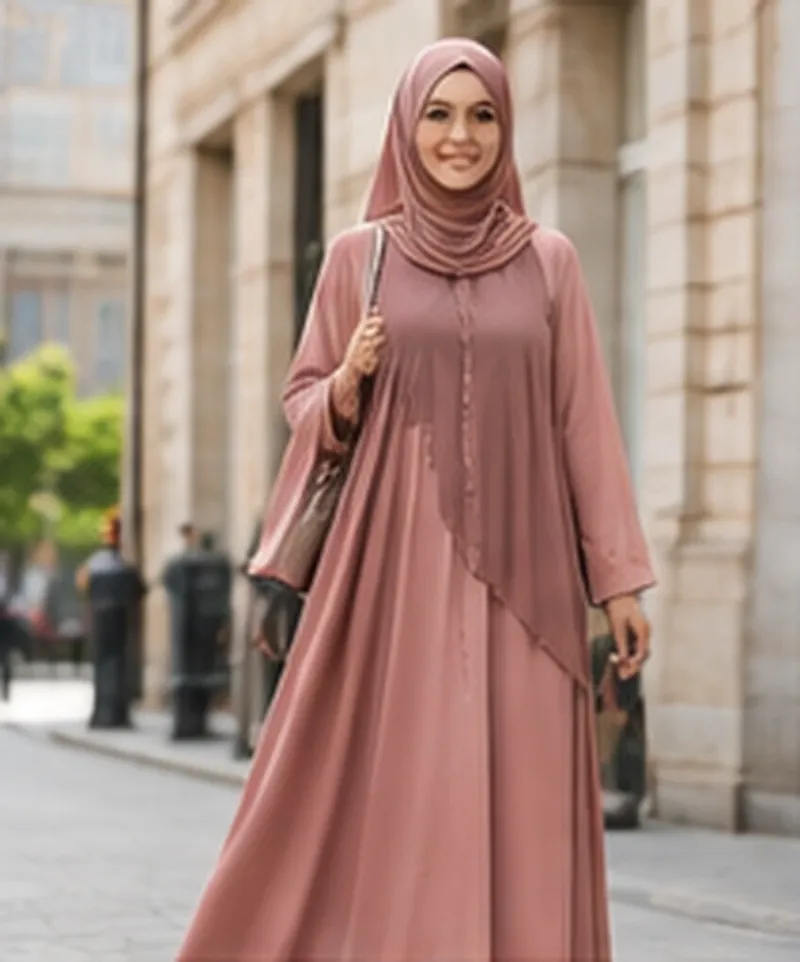
Muslim clothing for women across a continent-sized country
Muslim clothing for women in the United States covers an unusually wide field because the country itself is so varied. A woman in Minneapolis who needs a wool-lined coat in January, a student in Houston looking for a breathable outfit in August, and a lawyer in New York choosing something for court all work within the same broad idea of modesty but arrive at very different wardrobes.
Most Muslim women understand modesty as covering the body loosely and, for many, wearing a headscarf in public. Not all share that view. Some wear hijab daily, some wear it only at the mosque, and some choose loose clothes without a scarf. Scholars hold differing opinions on the details, and it is not for an outsider, or a shop assistant, to judge any of these choices.
American Muslim communities include families with roots in the Arab world, South Asia, West Africa, Somalia, Bosnia, Iran, Turkey and Southeast Asia, along with African American Muslims whose communities have a long history of their own. The result is a fashion scene where an abaya from the Gulf, a shalwar kameez from Karachi and a West African wrap dress can all appear on the same street.
Hijabs, abayas and Islamic women's clothing basics
In Muslim women's clothing, the hijab in the United States is most often a rectangular or square scarf in jersey, cotton, chiffon or viscose, pinned or tucked under the chin. Jersey is popular because it does not slip, and an under-scarf cap keeps hair in place. Instant hijabs, which slip over the head, appeal to women who are in a hurry or play sport.
An abaya is a long robe, open at the front or closed, that women put on over their regular outfit. In American cities it often takes lighter forms such as a duster-style cardigan, a kimono abaya or a belted shirt dress. The jilbab is a one-piece alternative that closes at the front, while the khimar is a long cape-style veil falling to the waist.
- Maxi dresses with a long-sleeved top or cardigan underneath
- Wide-leg trousers with a tunic that reaches the knee
- Long denim skirts paired with a roomy sweater
- Open abayas layered over jeans and a fitted shirt
Many women say the secret of Muslim clothing for women in America is layering: a good base, a long outer piece and a scarf that coordinates with both.
Dressing for Minnesota winters and Texas summers
Climate decides more of a wardrobe of modest wear here than in most countries. In the northern states and the Mountain West, a long wool coat, thermal leggings under a skirt and a fleece-lined scarf are practical essentials. A scarf can also serve as a neck warmer, and thicker headscarves in wool or cashmere blends are easy to find.
For Muslim clothing for women in the South, the Southwest and the humid Gulf Coast, the same principles bend toward light fabrics. Cotton voile, linen blends and rayon give coverage without trapping heat. Air-conditioned offices and shops then create the opposite problem, which is why a thin cardigan or long jacket is so often kept in the bag.
Rain and snow add another layer of planning. Women in Seattle or Boston often look for waterproof outer layers that fall below the hip, and ankle-length hems that do not drag in slush are sensible choices.
Work, school and sport: what the law says in general terms
American law protects religious practice in several ways. Title VII, a federal statute passed in 1964 as part of the Civil Rights Act, obliges bigger employers to allow for staff religious practice including clothing, short of causing undue hardship, while the Equal Employment Opportunity Commission deals with complaints. In 2015 the Supreme Court sided with a young woman who was turned down for a job over her headscarf, in the case EEOC v. Abercrombie and Fitch.
Public school students enjoy protection under the First Amendment, and many schools have uniform policies that can be adapted. Sports are changing too: American fencer Ibtihaj Muhammad won an Olympic medal in 2016 while wearing a hijab, and several major sportswear brands now make performance headscarves.
Treat this as a general overview and not as legal counsel. Rules vary by state, by employer and by situation, and a woman facing a dress-code dispute can contact a civil rights organisation or lawyer for guidance specific to her case.
Finding modest fashion for Muslim women in American cities
Regional hubs matter for modest fashion for Muslim women. In the Detroit area, Dearborn has long served Arab American families with abaya boutiques and fabric shops. New York has stores in Brooklyn and Queens, Chicago has clusters along Devon Avenue and in the suburbs, and Houston and Dallas have growing shopping centres devoted to South Asian and Middle Eastern fashion.
Online shopping dominates for many women, especially outside big cities. Designers and small Muslim-owned shops inside the country trade through personal websites and social networks, and foreign labels dispatch orders from Turkey, Malaysia, Indonesia and Gulf states. Mainstream department stores increasingly stock long cardigans and maxi dresses that work as modest wear without being labelled as such.
Thrift stores and vintage shops are an underrated source. Long skirts, silk scarves and oversized blazers appear there all the time, and a seamstress can alter a hem or add a lining for a small fee.
Choosing quality Muslim women's clothing
The two Eid festivals, al-Fitr and al-Adha, are the peaks of the year for buying clothes. Women often buy a new outfit for Eid morning, choosing colour combinations that coordinate with relatives, and many mosques hold Eid prayers in convention halls or stadiums, where seasonal weather may make a heavier coat necessary.
Weddings combine tradition and fashion in Islamic women's clothing. Pakistani and Indian families bring embroidered shalwar kameez and lehengas, Arab families favour beaded evening abayas, and Somali weddings are known for colourful dirac dresses and gold-toned scarves. Where mixed gatherings take place, some women choose a long-sleeved gown and a matching scarf, while at women-only gatherings many dress more freely.
Ramadan evenings bring their own routine. Taraweeh prayers call for comfortable two-piece sets or prayer dresses, and some women own a dedicated prayer garment, often a large cotton piece covering head and body, that can be worn over anything.
Quality, fabric and care
Reading labels pays off when buying Muslim women's clothing. Viscose crepe and chiffon drape beautifully but can be sheer, so an inner slip or lined skirt helps. Cotton blends hold shape better after repeated washing, and polyester performs well in travel but traps heat.
Care instructions differ for silk and satin scarves, which usually need a gentle wash and flat drying, while jersey scarves tolerate a machine cycle in a mesh bag. Magnets and flat pins replace sharp pins for women who prefer not to snag fabric.
Before buying online, check the return policy. The Federal Trade Commission oversees many aspects of consumer protection in the United States, and reputable sellers state their return window clearly. A size chart in centimetres or inches, with a garment measurement rather than only a label size, is a good sign.
Frequently asked questions
What do Muslim women wear in the United States?
There is no single outfit. Many wear a hijab with long skirts, maxi dresses, tunics and trousers or an abaya, adapted to local weather. Others dress modestly without a headscarf. Choices depend on personal conviction, family background and workplace.
Can an employer ban a hijab at work?
Under Title VII, employers generally must reasonably accommodate religious dress unless it creates undue hardship. Safety needs and the details of each job matter. This is general information; contact the EEOC or a lawyer for advice about a specific case.
Where can I buy modest fashion in the US?
Options include local boutiques in cities such as Dearborn, New York and Chicago, Muslim-owned online shops, overseas brands and ordinary department stores selling long cardigans and maxi dresses. Thrift shops and a good seamstress also help.
How does an abaya differ from a jilbab?
An abaya is usually an open or loosely closed robe worn over clothes, often black but now available in many colours. A jilbab is generally a one-piece garment closed at the front, sometimes with a hood. Terms vary by region.