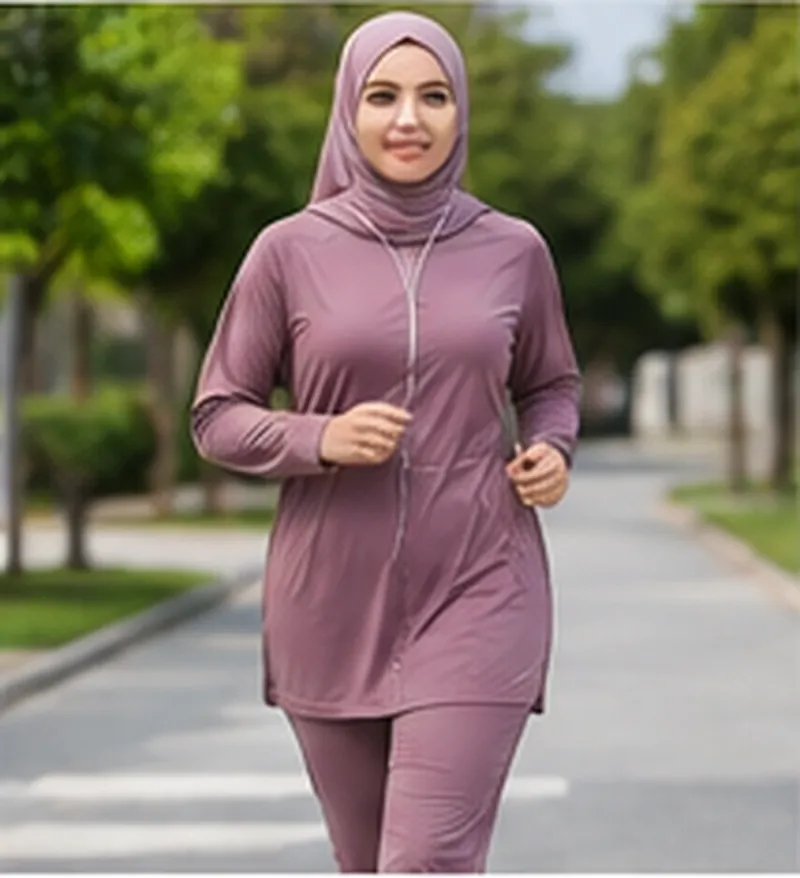
What makes a sports hijab different
Sports hijabs are built for three conditions that ordinary scarves handle poorly: heat, sweat and movement. A standard chiffon or cotton scarf can slide, loosen and trap warmth when you run or train. A purpose-made version uses fabric that stretches and recovers, seams that do not rub and a shape that sits securely without pins.
Many are pull-on styles, sometimes called instant or slip-on hijabs. The head opening is elasticated or tailored, the front sits neatly across the forehead, and the back drapes over the neck and shoulders. Some designs add a built-in cap beneath a longer panel, so there is no need to wear a separate undercap.
Athletic headscarves also vary by length. Short versions end at the neckline and suit gym sessions, medium ones cover the shoulders for walking and outdoor training, and long cuts give full coverage for those who want the chest and upper back covered as well.
Fabrics for sports hijabs that manage sweat and heat
Good fabrics for sports hijabs pull moisture from the skin and let it evaporate. Polyester and nylon blends with elastane are the usual base, often in a fine knit or a mesh. Cotton jersey is comfortable at rest but holds moisture and becomes heavy, so it is better for low-intensity sessions such as walking or yoga.
- Moisture-wicking knits: for running, circuit training and long gym sessions.
- Mesh panels: placed at the sides or the crown to let heat leave the head.
- Lycra-rich jersey: stretches for movement and returns to shape after washing.
- Bamboo or modal blends: soft and breathable for yoga, pilates and gentle exercise.
Dark colours hide sweat marks, while light colours reflect sunlight on outdoor runs. Flat seams kept clear of the forehead and ears prevent rubbing.
Running and walking in a running hijab
For running, weight and grip are the main concerns. A light running hijab with a snug band around the forehead stays put, and a longer back panel can be tucked into the top. Choose a length that ends at the collarbone so it does not flap, and test it on a short jog before a long run.
Visibility matters outdoors. Reflective details on the scarf or on your top help drivers see you at dusk. In summer, a pale shade and a ventilated structure keep the head cooler. In winter, a thermal fleece-lined version works under a hat, though a hat should be tested first so that the combination does not slip.
Remember that breathing needs to remain unrestricted. Make sure the fabric at the neck is not tight and that it does not cover the mouth during hard efforts.
Trail runners should also think about branches and snagging. A sport hijab with a smooth outer surface slides past twigs, whereas a loose-knit texture can catch, so inspect the weave before choosing it for off-road use.
Swimming, gym and studio classes
For swimming, many women use a close-fitting cap-style hijab in swimwear fabric, usually combined with a full-coverage swim top and trousers. These are cut to reduce drag, resist chlorine and stay fixed during turns. Remove them gently, as wet fabric clings, and rinse after every session.
In the gym, ventilation and hold are key. A cross-over or sleeve-style hijab allows a hood-like fit without a pin, and flat seams avoid pressure under a headset or a hat. For studio classes where you invert, such as yoga or pilates, a secure hijab with a longer back and a snug neckline avoids exposure when you move your head below your heart.
Changing rooms differ widely. Some facilities offer women-only sessions or private cubicles, and you can ask the operator about arrangements before joining.
Whichever setting you choose, bring a dry replacement to change into afterwards. A damp sports hijab cools quickly once you stop moving, which is uncomfortable in cold weather and can irritate the skin along the hairline.
Sport hijab choices for team and contact sports
In football, basketball, netball, hockey and martial arts, safety is the main question. The scarf should not pull on the neck if grabbed, and pins and hard clips are generally best avoided. Many sports have rules on head coverings, and governing bodies in several sports have revised their regulations over the years so that players can wear a headscarf in competition.
For that reason it is worth checking the current rules for your sport and your level of competition before buying. Some leagues ask for a specific design, a particular material or a colour that matches the team kit. In martial arts such as judo, a close-fitting cap-style covering is often preferred, because a loose tail can be gripped.
Coaches, referees and club officials are usually happy to talk through options if you raise it in advance.
For children and teenagers in school sport, ask the teacher about the uniform policy early in the year. Many schools have an approved sport hijab in team colours, and a ready-made option removes the awkwardness of improvising before a match.
Cycling, hiking and outdoor sports
On a bicycle, the hijab must sit smoothly under a helmet, with no loose ends near the wheels. Slim, one-piece styles are better than long wraps. A thin undercap under the helmet reduces friction and sweat, and helmets should always be tried on together with the scarf.
Hikers value warmth, sun protection and ease of removal. Light, quick-drying fabrics protect the neck from sun and wind. A buff or a neck gaiter worn over a sports hijab can add protection without adding another scarf to manage.
For all outdoor activities, check how the fabric handles rain, as some knits become heavy when wet.
Wind makes a larger difference than most people expect. A snug active hijab with a close neck seam stays still, whereas a floaty scarf can whip across the face, so pick the plainest cut for fast descents.
Fit and sizing for an active hijab
A good fit means the band sits securely on the forehead without leaving a mark and the fabric drops to a length you can control. Try the scarf while performing the movements of your activity: turn your head, bend, jump and reach. If it shifts, look for a silicone grip at the band, a closer cut or a layer of undercap.
Hair type matters too. Women with thick or long hair might prefer a slightly larger opening, while those who find slippery fabric a problem can pick a textured jersey. Tie hair back low and flat so that it does not create a bump.
Sizing is usually offered in simple bands, with child, small and adult cuts. When in doubt, choose the one that is easy to pull on without stretching the band to its limit, since fabric under tension wears faster.
Rules, views and everyday practicalities
Scholars and communities differ on aspects of women's participation in sport, such as mixed settings or the amount of body coverage in a given activity. Many Muslim women exercise in women-only sessions, in private spaces or in mixed sport while following the dress they consider appropriate. For a ruling on your personal circumstances, the best step is to consult a knowledgeable teacher within your own tradition.
On the practical side, wash sports hijabs after every use, as sweat and sunscreen build up quickly. Use a gentle cycle, avoid fabric softener, which clogs technical fibres, and air dry. Keep a spare in your bag for any session that might be followed by a meeting or a prayer.
Finally, remember that a running hijab can be part of an ordinary wardrobe: it can be worn for school drop-offs, walks and casual errands as well as for training, which makes the purchase more worthwhile.
Frequently asked questions
Can I wear a sports hijab for swimming?
Yes, but choose a swimwear version made from chlorine-resistant, quick-drying fabric. It should fit closely to limit drag, and you should rinse it after use to keep the elastic in good condition.
Which fabric keeps me coolest?
Lightweight, moisture-wicking polyester blends and mesh panels move sweat away from the skin. Cotton feels soft but stays wet, so it suits gentle exercise better than running. Seams that sit flat against the skin prevent chafing during longer sessions.
Are pins safe during exercise?
Pins can come loose or cause injury, particularly in contact sports, so most athletes prefer pull-on styles. If you use a fastening, choose a soft one and check your sport's rules.
How often should I wash it?
After each use, as sweat and sunscreen build up. Wash gently, skip fabric softener and dry flat, which keeps stretch and moisture-wicking properties for longer. Rinsing it soon after a sweaty session stops odours from setting in the fibres.