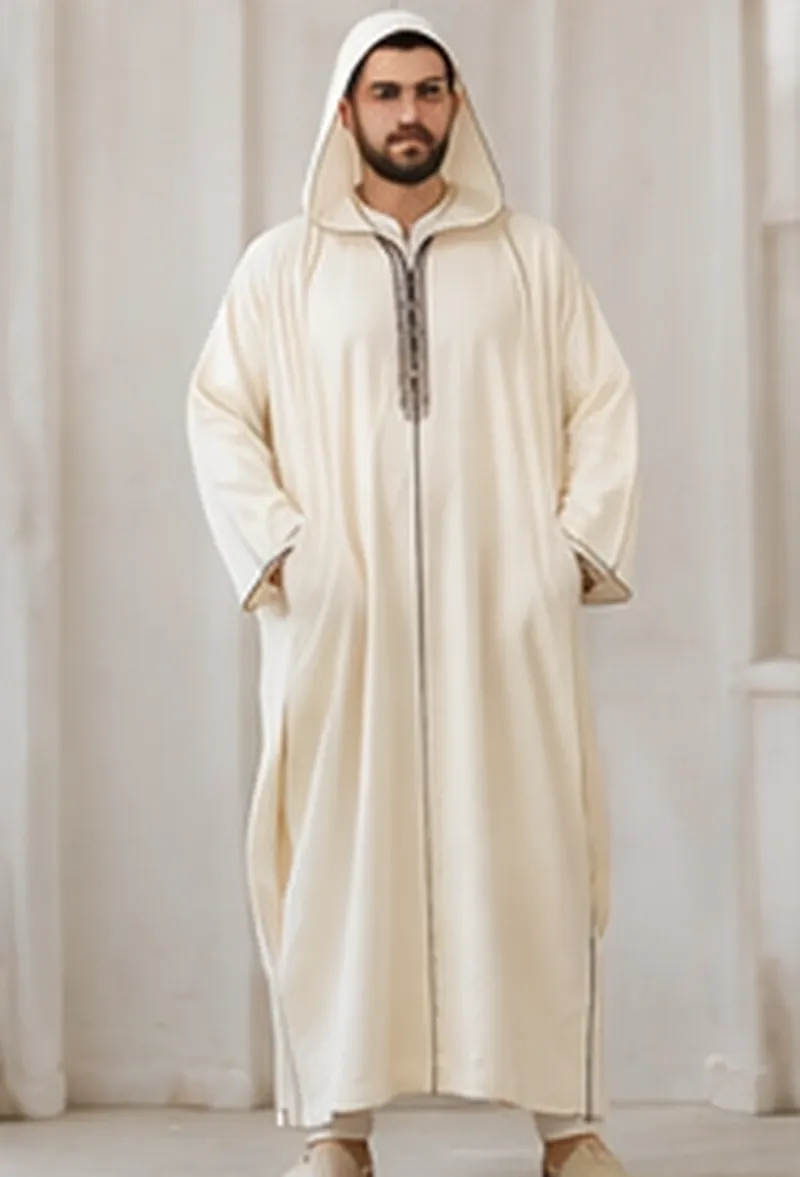
What a burnous is
A burnous is a one-piece hooded cloak, traditionally cut from a single wide length of woven wool, that falls from the head or shoulders to somewhere between the thigh and the ankle. It has no sleeves and is usually left open at the front, though a clasp or a few ties can hold it closed at the neck. The word comes from the Arabic burnus and the garment is strongly associated with the Maghreb, the region covering Morocco, Algeria and Tunisia.
The hood is part of the cut rather than an add-on, and it is often pointed or slightly peaked so that it stands up when drawn over the head. That shape sheds rain and blocks wind and dust, which explains why shepherds, travellers and townspeople all adopted the garment. Over time it became equally a piece of everyday protection and a marker of dignity and rank.
Because it is an outer layer, a burnous is worn over other clothes: a long shirt, a gandoura, a djellaba or a jacket and trousers. It is therefore less a replacement for ordinary dress than a finishing layer that shows tradition and status.
The selham and how it differs
The selham, written silham in Arabic, is the Moroccan version of the hooded cloak, and it is cut larger and more flowing than the common burnous. It is typically made of lighter, finer cloth, and it is most often seen in white or cream. In Morocco it is the formal cloak that men put on over a djellaba or a robe for Friday prayer, festivals and official ceremonies, and it is a familiar sight in photographs of royal and state occasions.
Where a burnous may be thick, napped and rustic, the selham is smooth, draped and ceremonial. It is often paired with a pointed hood, a plain belt-free line and, underneath, a spotless white garment. In daily life it is reserved for special days, whereas a rougher cloak can be worn on any cold evening.
The distinction is not rigid. In some places the two words overlap, and local usage varies from city to city, so a shop in Fez, a tailor in Oran and a weaver in the Atlas may each give slightly different answers about which name belongs to which cut.
Traditions across the Maghreb and beyond
In Algeria the burnous became a symbol of the countryside and of resistance history, and it remains a traditional wedding and festival garment in many regions. In the Kabyle and Berber mountain communities it is made of heavy wool, often in natural white or brown, and woven by women on a loom as part of household craft. The Algerian burnous sometimes appears as a gift to a groom or an honoured guest.
In Tunisia a lighter burnous is worn with a chechia and a tunic at celebrations and in the souk quarters, and in Libya and Mauritania similar hooded or draped outer layers exist under local names. In the Sahel and Saharan regions, cloaks and wraps adapt to the desert climate and the habits of nomadic communities.
Wool, cotton and the colours of the cloak
Wool is the classic fibre. It insulates, resists drizzle and wears for many years. A hand-woven cloak may feel dense and slightly rough, while a machine-woven one is softer and more uniform. Camel and goat hair appear in some desert styles for warmth and water resistance, and cotton or fine wool blends are used for the summer selham and for lighter formal pieces.
White and cream are the most widely worn shades, partly because they are associated with purity and festive dress. Brown, beige, grey and black belong to the working and winter side of the tradition. Some cloaks carry braided edges, fringes or embroidery along the hood, and these trims, called sfifa in Moroccan craft, are often hand-sewn and tell you about the garment's price and purpose.
Dyes also matter. Natural colours of undyed wool are favoured in rural regions, while urban tailors may use darker or richer shades for evening wear. If you are buying new, check how the colour is fixed, because a poorly dyed cloak can bleed when it gets wet.
How to wear a hooded cloak with confidence
A cloak of this kind sits on the shoulders rather than hanging from the chest, so the first step is to let it settle evenly and adjust the neckline. If there is a clasp, fasten it loosely at the throat; if there is none, let the front hang open and fold one edge over the opposite arm when you move.
Hood use depends on setting. In the street on a cold or rainy day it is raised over the head. Indoors, in a mosque or during a ceremony it is normally lowered onto the shoulders, and in formal photographs the hood may be arranged flat behind the neck so the line of the cloak looks neat.
Burnous, djellaba or bisht: choosing the right layer
A djellaba is a long robe with sleeves and a hood that is itself a complete outer garment, while a burnous is a sleeveless cloak worn over something else. If you want a self-contained piece that covers the arms, the djellaba suits; if you want to add a layer on top of other clothes, the cape is the better pick.
People sometimes ask how it compares with the bisht, the open cloak of the Gulf. The bisht is a lighter robe-like cloak with sleeves and a gold-edged trim, associated with ceremonial and official dress in the Arabian Peninsula. The two garments serve a similar purpose of dignity and protection but belong to different regions and have different cuts.
For a traveller, the practical question is climate. In a cold highland town a thick wool burnous makes sense, whereas on a warm summer evening a thin selham feels right. Having both in a wardrobe is an old habit in many Maghrebi households.
Occasions, etiquette and religious considerations
On Fridays and at the two Eids, a freshly pressed selham over a white robe is a respectful choice in Morocco, and many men wear it to the mosque. At weddings the groom may receive a white cloak from his family, and relatives sometimes mark the moment by helping him put it on. At funerals plain, darker garments are more usual.
From a religious point of view, a cloak is a cultural garment rather than a requirement. Islamic teaching asks for modest, clean clothing that covers what must be covered and avoids pride and extravagance. Whether a man chooses a cape, a robe or a suit is a matter of custom and taste. Differences between schools of thought and local practice exist, so a reader who wants guidance on a specific point should consult a qualified scholar.
Buying, caring for and storing a burnous
Look first at the weave and the seams. A good piece has even stitching, a hood that is properly joined at the neck and trimmings that are fixed securely. Heavier wool should feel dense without being stiff, and the fabric should drape when held by the shoulders. If you are buying for a child or a teenager, allow for some growth, as the cloak is meant to be generous.
Wool should be aired rather than washed often. Brush it gently, hang it in a ventilated place and use cedar or lavender in the wardrobe to deter moths. For stains, spot-clean with a damp cloth, and send heavy pieces to a specialist cleaner if they need washing. Never wring or tumble-dry a woollen cloak.
In Morocco, Algeria and Tunisia you can find cloaks in old-town markets and from tailors who work to measure. Elsewhere, specialist online sellers of traditional dress offer ready-made pieces. Ask for fibre composition and size details in writing, and keep the return conditions in mind when ordering from abroad.
Frequently asked questions
What is the difference between a burnous and a djellaba?
A burnous is a sleeveless hooded cloak worn over other clothes, while a djellaba is a long robe with sleeves and a hood that works as a complete garment. Many men wear a cloak over a djellaba on formal days.
Is the selham only for special occasions?
In Morocco the selham is mostly reserved for Fridays, festivals and ceremonies. A rougher burnous is more of an everyday winter layer. Practice varies by city and family, so follow local habits when in doubt.
Do I wear the hood up inside the mosque?
Normally the hood is lowered when entering a mosque or a home, as a sign of respect. It is raised outdoors in cold or wet weather. Local customs differ, so watch what other worshippers do.
How should I wash a woollen cloak?
Avoid frequent washing. Brush it, air it and spot-clean small marks with a damp cloth. For a full clean, use a specialist wool cleaner and never wring or tumble-dry it. Always follow the care label if there is one.