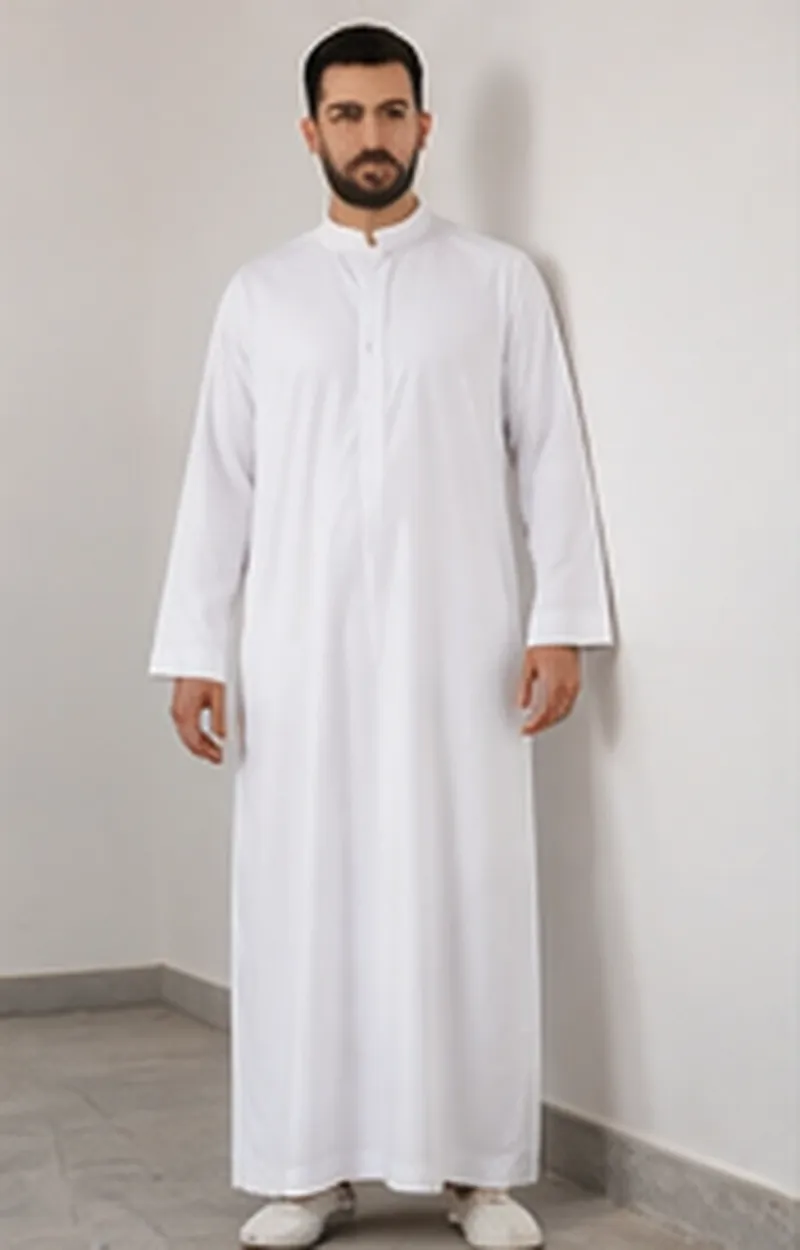
What a sleeveless waistcoat is and why it suits the qamis
A sleeveless waistcoat is a short upper garment cut to the torso, with armholes but no sleeves, usually fastened down the front by buttons, hooks or a single toggle. Worn over a qamis, the long collarless or mandarin-collared shirt-tunic found from West Africa to South Asia, it turns a plain white garment into a layered, finished outfit.
Since the qamis already reaches from shoulder down to shin or ankle, the qamis waistcoat is worn for style and layering rather than for coverage. Its job is shape and presentation. It gives a straight tunic a defined chest line, adds a second fabric and colour, and often supplies small pockets that a loose tunic lacks. That is why the combination is so common at gatherings where a man wants to look composed without wearing a heavy coat.
Because the armholes are open, the sleeves of the qamis stay visible and free. Many men like this for prayer days, since the forearms remain easy to uncover for ablution and the layer can be removed in a few seconds if the room is warm.
Regional names and styles you will meet
The same idea travels under many names. In the Arabian Peninsula and the Levant a short vest worn with a thobe is often called a sudayri, a word also written sidri or sudairi in Latin script. In Morocco a sleeveless layer under a djellaba or over a gandoura is known as a sedriya, and in the Maghreb generally the embroidered versions are tied to festive dress.
In India, Pakistan and Bangladesh the sleeveless layer is commonly called a koti or a waistcoat, and it sits comfortably over a kurta, which is the close cousin of the qamis. In East Africa, men on the Swahili coast pair a short vest with a kanzu, the local long white robe. Each region has its own preferred length, collar and trim, so a waistcoat bought for one tradition may look unfamiliar in another.
- Gulf and Levant: slim, often plain, sometimes with a V neck and a few front pockets.
- Maghreb: embroidered edges or braided closures, frequently in a contrasting colour to the shirt.
- South Asia: a stand-up or round collar, front buttons and shaped hems that sit at the hip.
- Swahili coast: lighter cotton or brocade cut, matched to a white kanzu and a decorated cap.
Cuts, collars and closures of the sleeveless waistcoat
The first decision is length. A sleeveless waistcoat that ends at the waistline gives a trim silhouette and suits shorter men or slimmer qamis cuts. One that reaches the hip adds balance to a longer tunic, while a longer line that skims the upper thigh gives the outfit a more formal, almost coat-like look.
Necklines fall into three families. A V neck lengthens the torso and shows the qamis collar clearly. A round or scoop neck is softer and more casual. A high band or standing collar echoes the mandarin collar of the shirt and makes the two garments read as one set. Closures range from plain buttons to fabric-covered buttons, hook-and-eye fastenings and frog loops, and each sends a different message about how dressy the layer is meant to be.
Fabrics and seasons for a sleeveless vest
Cotton and cotton-linen blends are the safest choice for warm climates, as they breathe and wash well. A lined cotton waistcoat gives a little weight for cool mornings without trapping heat. For winter, wool, wool blends and heavier tweed-like weaves keep the torso warm while leaving the arms free, which is why a heavier sleeveless waistcoat is a practical layer under a long overcoat.
Dressier fabrics include brocade, jacquard and dupion-style silk-effect weaves with a slight sheen. These are associated with weddings, Eid gatherings and engagement celebrations. Where a Muslim man follows the view that pure silk is not permitted for men, he can look for synthetic or blended silk-effect cloth instead. Scholarly opinions on this question are not identical across schools of law, so anyone who is unsure should ask a qualified scholar they trust.
Whatever the cloth, look at the lining. A smooth viscose or cotton lining lets the waistcoat slide on over the qamis; a rough lining will catch and ride up. The weight of the shirt matters too: a very thin voile qamis underneath calls for a lighter sleeveless waistcoat so the layers do not look mismatched.
Getting the fit of a qamis waistcoat right
A white qamis is the easiest base because almost any waistcoat shade works against it. Navy, charcoal and black feel formal; deep green, burgundy and brown feel warm and traditional; sand, grey and stone are quiet and suit daily wear. Embroidered edging in gold or tone-on-tone thread lifts a dark qamis waistcoat for celebrations.
With a coloured qamis, keep the waistcoat within the same family or choose a neutral. A light blue tunic looks sharp with navy, while an olive or beige tunic works with brown or cream. Avoid putting two strong colours against each other, because the sleeves of the qamis are fully visible and will compete with the vest.
Getting the fit right
Check that the seam at the top lands right where your shoulder ends, and that the openings for the arms are cut high so they do not sag away from the body. When the qamis has a generous cut, a sleeveless waistcoat that is too tight will pull the fabric into folds across the chest, so try the layer on over the actual shirt rather than over a T-shirt.
Chest room is checked by buttoning the front and sitting down. If the buttons strain or the hem rides above the belt line, size up or choose a style with a side adjuster at the back. Tailors who work with traditional dress can add a hidden strap or a small buckle so the waistcoat can be taken in later.
Length against the qamis matters visually. The shirt hem should always fall well below the waistcoat, so that the two layers form a clear step. If the vest nearly reaches the qamis hem, the outfit looks like a short robe instead of a layered set.
Occasions: from the mosque to the wedding
For Friday prayer, a plain waistcoat in a muted shade is enough. It looks tidy, stays out of the way during prostration, and does not carry decoration that might distract. Some men prefer to remove it at the start of prayer if the fastenings are bulky or the lining is slippery, which is easy because there are no sleeves to pull off.
At weddings and Eid, embroidery, brocade and contrast piping are welcome. A groom might wear a sleeveless waistcoat in a rich shade over a white qamis with a matching cap, while guests choose quieter versions. In professional settings, a tailored dark waistcoat over a clean white qamis can replace a jacket and still read as smart.
Funerals and condolence visits call for simple, dark or neutral pieces with no shine. Customs differ from one community to another, so it is worth watching what relatives and neighbours wear before choosing.
Looking after a waistcoat and choosing well
Check the care label before washing. Lined or embroidered waistcoats are often best spot-cleaned or dry-cleaned, while plain cotton can go in a gentle machine wash inside a mesh bag. Hang the garment on a shaped hanger rather than folding it, because creases at the front edge are difficult to remove.
When buying online, compare the measurements given for chest width and length rather than relying only on a size letter, and look at pictures of the inside seams if they are shown. In a local shop or with a tailor, ask to see how the buttonholes are finished; clean, dense stitching is a sign of a garment that will last.
Frequently asked questions
Is a waistcoat appropriate to wear during prayer?
Yes, a plain qamis waistcoat is generally fine, provided it is clean and the clothing covers what is required. Some men take it off if the fastenings are bulky. Anyone with a specific question about prayer dress should consult a qualified scholar.
What length should the waistcoat be over a qamis?
Most men choose a hem at the hip, which balances a long tunic. A waist-length style looks sharper on slim cuts, and a thigh-length style feels more formal. The qamis should always extend visibly below the sleeveless waistcoat.
Which colours go best with a white qamis?
Navy, charcoal, deep green, brown and burgundy all work well against white, and sand or grey suit everyday wear. For celebrations, gold or tone-on-tone embroidery on a dark waistcoat gives a richer look without clashing.
Can I wear a waistcoat in hot weather?
Yes, if you choose a light cotton or cotton-linen version with a thin lining. Open armholes let air move around the sleeves, and the layer can be removed quickly once you are indoors or the day warms up.