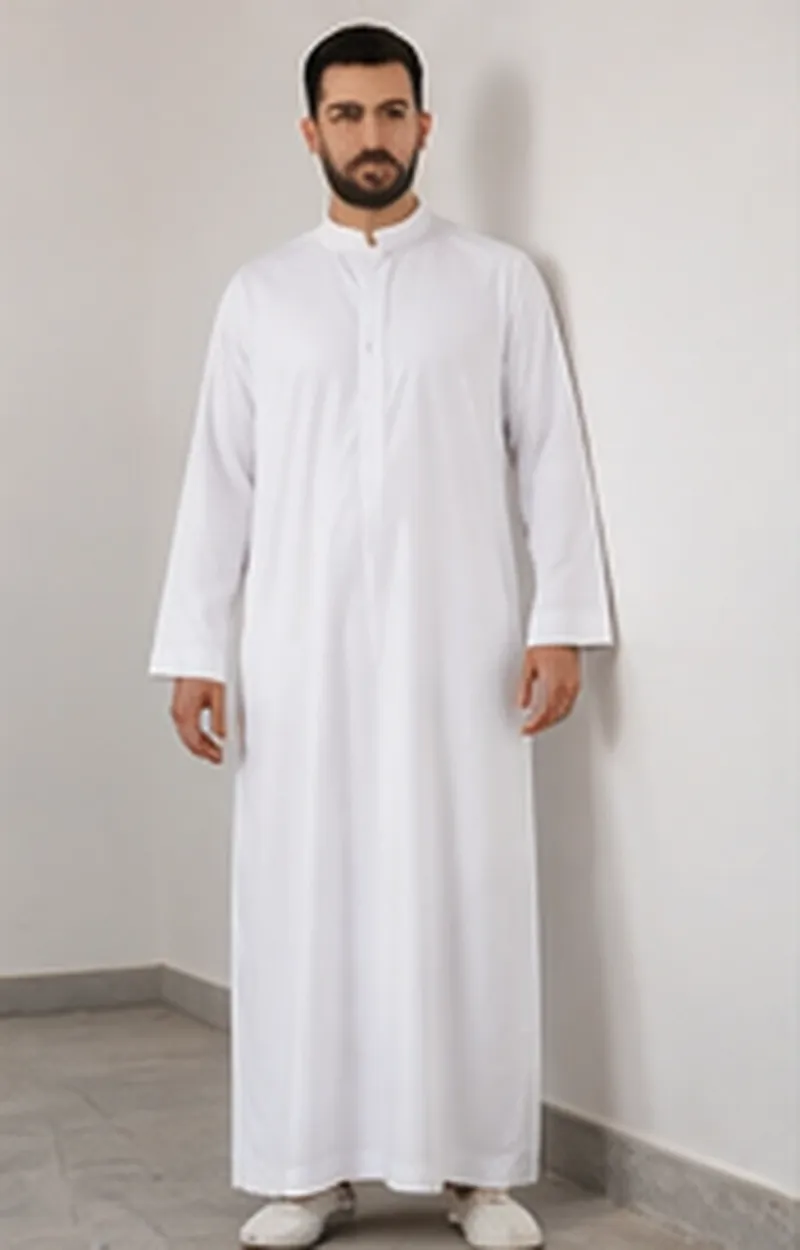
Qamis, thobes and jubba robes: three related names
The three names appear in different parts of the world, and they often overlap. Qamis, from the Arabic word for shirt, is the term many English speakers use for a long shirt-like garment worn over trousers or with an inner layer. Thobe, spelled thawb in Arabic, is the ankle-length robe worn across the Arabian Peninsula and in many other Arabic-speaking countries. Jubba, or jubbah, describes a longer, looser outer robe, sometimes open at the front.
These are not rigid categories. In some regions the same garment is called by several names, and in others the names refer to distinct cuts. Together they form the family of long robes, and what they share is a loose, long silhouette that covers the body, suits warm climates and has a long history as everyday and festive dress.
Choosing between them is partly a matter of climate, partly of occasion and partly of local habit. A man in the Gulf will probably reach for a thobe; a man in East Africa or South Asia may think first of a qamis; a scholar in many places will own a jubba for formal gatherings. Men's thobes, qamis robes and jubba robes can all be found in cotton for summer and wool for winter.
Cut, collar and cuff: how men's thobes are built
The classic Gulf thobe, the best known of the long robes, is a straight, ankle-length robe with long sleeves, a small stand-up collar and a short placket at the front. Collars are usually soft and button-fastened, and gulf styles differ from country to country in the shape of the collar, the cuff and the sleeve, so a tailor will ask which national cut you prefer.
Moroccan and Egyptian equivalents differ in line and decoration. The Egyptian galabeya is an easy robe in cotton, while the Moroccan jellaba includes a hood. Because these garments have their own pages, the focus here is on the straight shirt-robe family.
The qamis, as worn in South Asia and among many communities in the West, tends to be shorter, often falling to mid-calf, and is worn with trousers. Collar styles include the mandarin band, the open shirt collar and the collarless round neck.
Jubba robes as outer layers
A jubba is generally a wider, longer outer robe that can be worn over a qamis or thobe. In some regions it is a fastened, coat-like robe, and in others it is an open, sleeved garment similar to a cloak. In several regions, scholars and religious teachers have long worn the jubba for formal and teaching occasions.
In many Muslim communities, jubba robes are also an occasion garment. It is used for Friday gatherings, festivals, weddings and when leading prayer. In such cases it is often made from heavier cloth with discreet embroidery at the neck and cuffs.
A practical advantage is warmth: a jubba worn over a thin qamis gives layered protection in cool weather without a coat.
Fabrics for long robes in hot and cold climates
For long robes, cotton is the standard for hot climates because it is breathable and holds up to frequent washing. Linen is cooler and more textured. Polyester blends dominate in the Gulf for their crease resistance and smooth fall, though they can feel warmer in summer. In colder months, wool, wool blends and brushed cottons provide insulation.
- Cotton: soft, breathable and easy to dye; the everyday choice.
- Linen: very cool, naturally textured, but prone to wrinkling.
- Poly-viscose or polyester blends: crisp, wrinkle-resistant and easy to care for.
- Wool and wool blends: for winter jubba and thobes.
Opacity is an important quality in white garments. A thin white fabric may be see-through in sunlight, so heavier weaves or a lining are advisable.
Length, fit and the question of the ankle
Lengths vary between traditions. Some men wear long robes reaching to the ankle, others prefer mid-calf, which is both practical and consistent with the way many people read the guidance on clothing. A qamis worn with trousers is often shorter than a thobe worn alone.
Fit also differs. A traditional robe hangs loosely, while a modern tailored version may be slimmer through the chest. For prayer and movement, enough room at the shoulder, armhole and hem is important. Pockets at the sides or the chest are common.
On the matter of exact length, there are different interpretations among scholars of how far garments should descend, and communities follow different practices. Those who want a ruling on their own dress should consult a qualified scholar.
Younger men often prefer a trimmer cut and a shorter hem in qamis robes, while older relatives keep the traditional fuller shape. Both are accepted in most communities, and the difference is usually a matter of generation and taste rather than principle.
Colours and occasions
White is the colour most closely associated with the Gulf thobe, especially in warm months and for Friday. Greys, creams, navy, black and brown are worn in cooler seasons and at work. Colours vary by country and age, and some families favour particular shades for weddings or religious festivals.
For everyday life, a plain qamis in a neutral colour is practical and easy to match with a prayer cap or a scarf. For Eid and weddings, finer fabrics, embroidered collars and a matching waistcoat are common. For formal gatherings in the West, many men choose a thobe in a solid dark colour with a jacket.
A practical tip for colour is to own one white and one dark robe before experimenting. They cover most needs, from the mosque to a business meeting, and the rest of the wardrobe can be built around them.
Headwear and accessories that go with them
Men's thobes and jubba robes are worn with varied headwear. In the Gulf, the ghutra or shemagh, a square of cotton, is held in place by an agal, a black cord ring. A white knitted or embroidered cap, the taqiyah or kufi, is worn widely across the Muslim world and is often placed under a scarf. Turbans are used in several regions.
Footwear ranges from leather sandals to simple shoes. Belts are optional in robes, but common over a jubba. A pocket watch or a miswak, a natural tooth-cleaning stick, may be carried in the chest pocket.
Buying a thobe and keeping it crisp
When buying qamis robes, check shoulder width, sleeve length and hem. Tailors can adjust the length and take in the side seams, but altering a collar or shoulder is harder. Pay attention to the buttons and plackets, which take the most wear. Purchase from sellers who show the fabric weight and the real colour in daylight.
To care for these garments, wash according to the label, hang them to dry and iron while slightly damp. White robes benefit from separate washing to stay bright. Store on a wide hanger to avoid shoulder dents, and keep spare buttons from the original purchase.
Many men also keep a plain thobe or qamis for travel, because the fabric packs small and can be refreshed with a steamer. Check that the collar stays upright after folding, and carry a small lint brush for dark cloth.
Frequently asked questions
What is the difference between a qamis and a thobe?
Both are long shirt-like robes. The word thobe is common in Arabic-speaking regions for the ankle-length garment, while qamis is often used for a long shirt, sometimes shorter, worn over trousers.
Is a jubba the same as a thobe?
Not usually. A jubba is generally a wider outer robe worn over another garment, whereas a thobe is the main robe. Regional naming varies, so the same word may mean different things.
Which fabric is best for a white robe?
A medium-weight cotton or cotton blend with a tight weave stays opaque and breathable. Very thin cloth can be see-through in strong sunlight. A lining at the chest or a heavier weave keeps white robes comfortable in bright light and protects against stains.
How long should the robe be?
Practices vary from mid-calf to the ankle, and scholars hold different views. Select a hem that feels easy for both prayer and walking, and seek a knowledgeable teacher's view if you would like more direction.