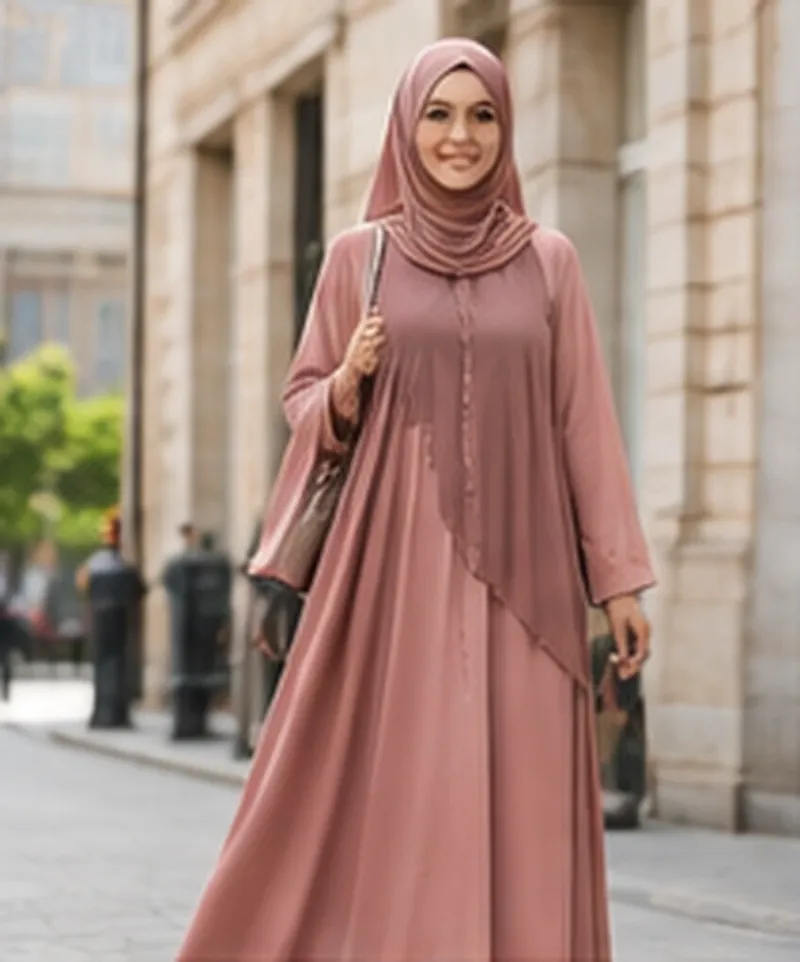
What neck covers are and when they help
Neck covers solve a very ordinary problem: clothing is rarely designed with a hijab in mind. Many tops dip at the front, and many scarves leave a gap at the throat when the wearer turns her head, lifts her arms or leans forward. A separate piece of cloth bridges that space and keeps the outfit tidy from every angle.
They suit women who like to buy ready-made clothes, work in uniforms or live in warm climates where thick scarves are unpleasant. They also help teenagers who are trying out a hijab for the first time and want a smooth, reliable layer that does not need pinning.
Neck covers are also valuable for women who wear thin or silky scarves that shift as they move. Placed underneath, the cover acts like a quiet inner collar, holding the scarf up and keeping the front smooth, so the hijab itself needs fewer pins and less adjusting during the day.
Neck gaiters, tubes and inserts compared
A neck gaiter is a stretchy fabric ring worn around the neck, similar to a short and wide collar. A neck tube is a longer version that can reach over the shoulders and chest. A neckline insert is a small panel or false front that sits inside a V-neck or a button-front top, stopping at the chest. Modesty collars are decorative, often with lace or ruffles.
Each has its place. Gaiters are the fastest to put on and suit casual wear. Tubes give broader coverage under loose tunics and abayas. Inserts work best in garments with a deep opening where a gaiter would show a hard edge. Collars add an ornamental detail for festive and formal outfits.
Some designs combine two functions, with a neck tube that is joined to a bonnet cap or a hood. These are popular for sport and school, where a single piece is easier to manage.
Fabrics and finishes for comfort
Because neck covers and neck tubes sit against sensitive skin, softness comes first. Cotton jersey, modal and bamboo blends are comfortable and breathable. Viscose jersey drapes smoothly. Nylon-elastane microfibre dries quickly and suits sport. Fleece or brushed knits keep the neck warm in winter, though they add bulk under a collar.
- Cotton jersey: soft, breathable and easy to wash; can lose shape after many cycles.
- Modal and bamboo blends: smooth and cool; good for long days indoors.
- Microfibre: slim, quick-drying and often seamless; suited to sport and travel.
- Fleece and wool blends: warm layers beneath coats.
Check the edges. A bound or double-folded hem lies flat against the skin, while a raw edge may curl and rub. Flat seams matter more than people expect when the piece is worn all day.
Choosing size, height and colour
Height decides how much of the neck is covered. A short piece ends just under the chin and works with a shirt collar. A taller one reaches the jaw and is useful under open-neck tops. Width decides how far it spreads across the chest. Try the cover with your usual tops and scarves, because a piece that fits perfectly under one garment can show at the edge of another.
Colour can be chosen to match the top, the scarf or the skin. Matching the top gives the neatest result when the neckline is wide. Matching the scarf creates a continuous line from the head to the chest. Skin-tone shades vanish under thin or light fabrics but are only convincing if the match is close.
Avoid shiny fabrics if you want the cover to disappear, as the sheen reflects light and attracts attention to the join.
Think about how often you turn your head in your day. Drivers and people who work at a desk with a monitor move the neck constantly, so a stretchy gaiter that follows the movement is more comfortable than a rigid insert that stays in one place.
Layering neck covers under dresses, shirts and abayas
Under a button-up shirt, a neck cover allows the top buttons to be undone for comfort while still keeping the neckline filled. Under a wrap dress, an insert fills the V and sits flat beneath the crossing fabric. Under an abaya with an open collar, a tube prevents the garment from gaping when you bend.
When wearing a hijab, check the point where the scarf meets the cover. Tuck the cover under the scarf so its upper edge is hidden, or let the scarf fall over it without pulling. Pins are rarely needed, because the stretch of the neck piece keeps it in place.
For a polished look, choose a cover slightly lighter than the outer layer to add depth, or the same tone for a seamless result.
Neckline inserts also help with special garments. A lace blouse, a V-neck wedding dress or a deep-collared kaftan can be worn with a matching insert, so that the shape of the original design remains while the throat and upper chest are covered.
Seasons and activities for neck gaiters
In summer, thin cotton or microfibre covers feel lighter than an additional scarf and reduce the sweat that gathers at the collar. In winter, a warm tube offers insulation and protects the throat from wind without extra bulk. Layering with a thick coat works best if the cover is thin enough not to push the collar away from the neck.
For sport, a neck cover that fits snugly around the neck stays in place during exercise and protects the area from sun. Cyclists and runners often prefer a seamless version to avoid chafing. For work, neat colours and flat seams ensure that the piece goes unnoticed.
For travel, neck covers are compact and quick to wash, so a pair can be packed for each day of a trip.
Weather changes what you need from the piece. In humid climates, choose an open-knit cotton neck cover that lets air pass, and wash it more frequently, because moisture and warmth encourage odours near the collar.
Coverage questions and personal choice
How far a woman covers her neck and chest is a matter on which Muslim scholars and communities have differing views, and local customs also vary. Many treat the neck and upper chest as part of what a headscarf should cover, while others focus on different parts of the dress code. A neck cover is a tool that lets each woman follow the position she considers right without changing her entire wardrobe.
If you are uncertain, ask a qualified scholar from your tradition or a knowledgeable member of your community. Remember that coverage is only one aspect of dress, and comfort, hygiene and respect for others are equally relevant parts of the conversation.
Coverage is also something that evolves over a lifetime. A woman might begin with neck covers while she adapts to a new style of dress and later choose different solutions, and none of these stages needs to be justified to anyone else.
Care, buying and replacing
Neck covers sit near the skin and collect sweat, make-up and oils, so wash them often. A gentle machine wash in a mesh bag is usually enough. Avoid softener, which makes fibres slippery, and dry flat to protect the elastic.
When buying, check the stretch by pulling gently and releasing: it should return to its shape. Look for tags that are removed or stitched flat, because labels at the neck can irritate. Buy two or three in neutral shades to rotate during the week, and replace them when they bag out or the colour fades noticeably.
If a piece begins to look worn, retire it to home use and keep newer neck gaiters for outside the house. That way the best items last longer and your wardrobe always has a fresh option available.
Frequently asked questions
What is the difference between a neck cover and a scarf?
A neck cover is a small, shaped piece, often stretchy and seamless, which fills a neckline. A scarf is a larger piece worn over the head or shoulders and needs wrapping or pinning.
Will a neck cover show under a thin top?
It can if the colour or the edge is visible. Choose a shade close to the top or the skin, a flat seam and an opaque fabric, and test the combination in daylight.
Can I wear one under a hijab?
Yes. Tuck the upper edge under the scarf or let the scarf fall over it. Because it is stretchy, it usually stays in place without pins. If the edge peeks out, a slightly longer cover or a different fold usually solves the problem within a minute.
How many should I own?
Two or three in neutral colours is enough for most people, so you can wash one while wearing another. Add a warm winter piece and a thin summer one if you live where seasons change.