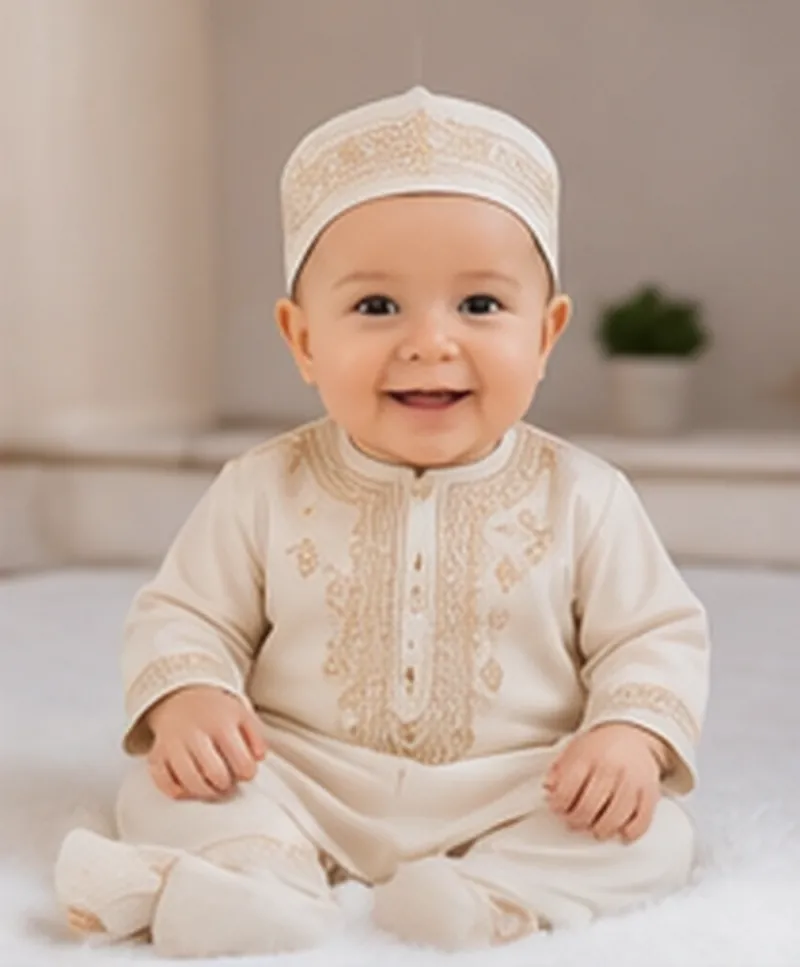
What baby harem trousers are
Baby harem trousers are a miniature version of the baggy, gathered trousers that originated in the Middle East and Asia, adapted for infants. The seat and thighs are cut full, the crotch hangs low and the ankle ends in a narrow cuff or elastic. Whereas adult versions can be dramatic, baby versions are usually restrained: a rounded silhouette, soft fabric and a gentle elastic at the waist.
The shape is not decorative alone. A baby in a nappy has a wide base, and ordinary slim trousers can pinch the thighs or ride down. The extra room in a harem cut accommodates cloth nappies and thick disposables easily, and it leaves the legs free to wiggle. For crawlers, the generous seat does not pull when the child kneels.
Families who prefer loose, modest dress for children also like the style because it matches the cut worn by older siblings and parents. A baby in a soft cotton tunic and loose trousers looks coordinated with a family that wears long shirts and baggy trousers.
Why a flexible waistband matters
The waistband is the most important detail on a pair of baby trousers. A baby has a round tummy, which grows noticeably after a feed, and a stiff or tight band leaves red marks and discomfort. A soft, wide elastic distributes pressure and gives way when the stomach expands.
Some brands offer waistbands with a fold-over panel, which can be turned down below the belly for newborns and pulled up as the baby grows. This prolongs the life of the trousers and prevents pressure on the umbilical area in the early weeks. Others use a drawstring that is stitched inside to stop it pulling out; avoid long free ties, which are hazardous.
Test the band by stretching it. It should return to its shape without leaving a harsh pinch. Slide two fingers beneath the band while the trousers are on the baby; they should move without force. If the band slips, the trousers are too large or the elastic has weakened.
Making room for nappies
Cloth nappies are bulkier than disposables, and parents who use them often size up in trousers. A baby harem pair with a deep crotch and roomy seat is helpful, because the extra fabric is already part of the design. Disposable nappies can leak up the back, so the ability to see the tapes and fasten them without wrestling with tight fabric is helpful.
Some designs include a button or snap at the crotch, which makes changing faster. Others rely on a wide waist so that the whole trouser can be pulled down quickly. In either case, check that the garment does not stretch over the nappy so tightly that it presses on the groin or thighs.
At night, a baby may sleep in a nappy and a bodysuit, with loose trousers added in cold seasons. Make sure the trousers cannot ride up and bunch around the knees, and keep layers light to avoid overheating.
Choosing the size and length of baby trousers as the baby grows
Length in baby clothing is flexible. A cuff that gathers at the ankle can be folded up for a small baby and let down as the legs lengthen. Sizes are given in months, but fit is better judged by weight and length, which are on the label in many brands. Measure the baby's inside leg and compare with the brand chart.
A pair that is slightly large lasts longer, but be careful that excess fabric at the feet does not trip a baby who is learning to stand or walk. Crawling babies often wear out the knees, and a double layer or a patch there extends the life of the trousers.
Be realistic about how long the trousers will fit. Babies change fast in the first year, and a pair may serve for only a few months. Many parents buy two or three pairs in successive sizes, so they always have something that fits.
Fabrics for babies: cotton, muslin and jersey
Soft cotton is the default for baby trousers. Cotton jersey offers stretch and warmth, while muslin cotton is airy and suits hot weather. Brushed cotton or light fleece adds warmth in winter without bulk. Viscose from bamboo is soft and smooth, though it is delicate in the wash.
Avoid stiff synthetic fabrics which do not breathe, and be cautious with heavy denim-like materials, which can rub the thighs. The inside of the garment should feel smooth. Seams should be flat, and elastic should be covered by fabric on the inside.
Colour choices tend to be neutral. Cream, grey, sand, sage and soft blue go with most tops and hide marks. Subtle prints such as small stars, crescents or stripes appear in many collections for families who like a gentle Islamic motif. Stay away from prints that use dyes with a chemical smell.
Dressing baby harem trousers with tops and layers
The loose lower half balances best with a fitted or moderately loose top. A cotton bodysuit tucked inside, a long-sleeved T-shirt or a short tunic works well. For a more traditional look, pair the trousers with a small qamis or a kurta, which covers the waistband and creates a coordinated set.
In cool weather, add a cardigan, a hooded top or a knitted jumper, and put socks or booties over the cuffs. Because the cuff narrows at the ankle, socks stay in place better than with straight legs. Add a hat, plus a thin blanket over the car seat, and the baby is ready to go outside.
In summer the combination of loose trousers and a light cotton top allows air to circulate. Baby harem trousers are also a good choice for sun protection, as they cover the legs without clinging. Shade and sunscreen guidance from your health visitor still applies.
A final check before leaving the house is to look at the baby from the front and the side: the waist should lie flat, the cuffs should sit at the ankle and the seat should hang without dragging, so the baby can move freely in the pushchair or on the floor.
Washing and storing baby trousers
Follow the label. Cotton trousers for babies usually tolerate a machine wash at a medium temperature, using a gentle detergent without perfume. Wash new pairs before first wear to remove finishing agents and soften the fabric. Turn the garments inside out to protect prints.
Elastic waistbands wear with heat. Where you can, skip the hot dryer and let them dry lying flat or hung on a line. Overstretched elastic loses its recovery, and a band that sags may need replacing. Stains from food and nappy leaks are best treated early with cool water and a gentle stain remover.
Store pairs folded, not hung, to avoid stretching the waist. Keep them in a drawer with other soft items. Clothes that are still in good condition can be handed on to another family, which is a common and welcome practice among relatives.
Frequently asked questions
Are baby harem trousers comfortable for nappies?
Yes. The low, roomy seat leaves space for cloth and disposable nappies alike, and the soft waistband expands with the tummy. Check that the elastic is gentle and that the fabric does not press on the groin.
What waistband is best for a baby?
A wide, soft elastic covered with fabric is best. A fold-over panel is useful for newborns. Avoid tight or narrow bands and long free drawstrings. You should be able to slide two fingers beneath the band easily.
Do loose trousers help with crawling?
They can. The roomy seat and soft cut do not pull at the knees. However, loose fabric around the feet should be taken up with a cuff so it does not trip an infant who is starting to pull up and stand.
How many pairs does a baby need?
Most families keep three to four pairs for the current size, because accidents and leaks are common. Washing and drying take time, so a small stack ensures there is always a clean pair, and the next size can be bought as the baby grows.