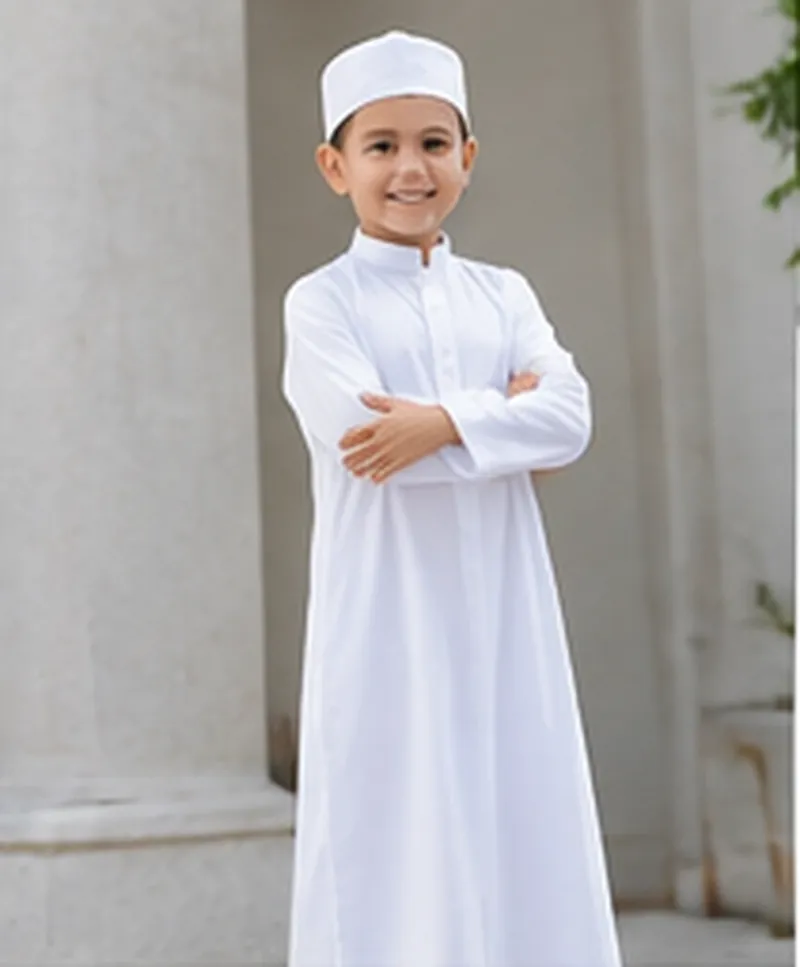
What a kufi or taqiyah is
A kufi is a brimless cap that sits close to the head, usually rounded or slightly flat on top, and made from cotton, wool, crochet or embroidered cloth. The Arabic term is taqiyah, and in different countries the same cap is called a topi, a takke, a peci or a songkok. For boys it is a very small garment, often the first item of religious dress a child wears, and it can be chosen as much for its charm as for its function.
The word kufi is common in English, especially in West Africa and in African American communities, where the cap is a familiar symbol of cultural identity as well as faith. In the Arab world, taqiyah is the usual word, and a white knitted or sewn skullcap is a familiar sight in mosques.
Unlike a scarf or a turban, the cap is not wrapped. It is simply placed on the head, which makes it ideal for children who dislike fuss. Many boys have a small collection and choose which to wear according to the occasion.
Regional caps around the Muslim world
The shape and decoration of the cap tell you something about where it comes from. Families often choose a style that echoes their heritage, and a boy may own more than one.
- Arab taqiyah: usually white, plain or perforated cotton, worn under a folded headcloth or alone for prayer.
- West African kufi: a flat-topped or slightly structured cap, in cotton or woven cloth, often decorated with embroidery or pattern.
- South Asian topi: a prayer cap, plain white or coloured and at times finished with delicate openwork, that boys put on for Friday prayer and throughout Ramadan.
- Malay and Indonesian songkok or peci: a black, stiffened cap, usually of velvet, worn by men and boys at weddings, Eid and national events.
- Turkish takke: a small, round cap, often in white and sometimes with embroidery or decorative edging.
- Afghan and Pakistani wool caps: the rolled-edge pakol and the pillbox cap are popular in cold weather, usually in wool.
Each cap carries local meaning and local etiquette. A boy raised in Kuala Lumpur and a cousin from Kano may both call their cap by different names, yet the intention is the same: a modest, neat head covering for worship and community occasions.
Is wearing a kufi required? Different views
Wearing a cap is generally regarded as a custom and a mark of respect, not a duty. Within the main schools of Islamic law there are varying opinions: some scholars consider a covered head for prayer to be recommended, while others see it as optional, and traditions differ about whether a bare head is acceptable at all. These differences are well known, and no single custom speaks for the whole community.
For children there is even more room for flexibility. Many families introduce the cap as a playful habit, teaching a boy to wear it for prayer or the mosque and allowing him to leave it off during play. The important thing, in the view of most parents, is that the child associates it with something positive.
If a family wants clear guidance, a qualified scholar in their own tradition is the right source. The following sections concentrate on practical matters, such as materials, fit and care, rather than on rulings.
Materials and construction: cotton, crochet and wool
The material of a kufi decides how it feels. Cotton is the standard for warm weather: it breathes and is gentle on the scalp. Crocheted caps use cotton thread and have an open texture that allows air through, which makes them popular for long summer prayers. Wool caps keep the head warm in cold climates and are common in Central Asia and mountain regions.
Embroidered caps are decorative. They may carry thread work in geometric patterns, Arabic calligraphy or floral motifs. For a boy, avoid designs where the embroidery is stiff or scratchy on the inside, since it will lie against his forehead for hours. A soft lining or a smooth reverse side prevents irritation.
Some caps use a stiffening layer, which holds the shape and is typical of the peci and songkok. These are formal and less comfortable for all-day wear. Boys usually prefer a soft cap that can be folded and put into a pocket after prayer.
Sizing and fit for a boy's kufi
A kufi should stay on the head without squeezing. Run a soft measuring tape around the head, level with the brow and the tops of the ears, then match the number to the maker's size guide. Child sizes are often sold as small, medium and large, and the actual dimensions differ between makers, so look for a stated circumference rather than relying on age.
Crochet caps stretch slightly with wear and fit a range of head sizes. Stiffer caps have no give, so be accurate. A cap that is too loose slips during prostration and distracts the boy; one that is too tight leaves a red line and may cause a headache.
Check how the cap sits with different hairstyles. A boy with thick, curly hair may need a slightly larger size, and one with short hair might find a smooth cap slides. Some mothers sew a small piece of non-slip tape inside the rim to keep the cap in place during movement.
Colours, patterns and matching with clothing
Plain white is the commonest shade, above all on Fridays, and it matches any robe or shirt. Black and navy suit formal dress and look especially sharp with a white thobe. Boys who like colour can choose red, green or blue, and children's caps with small stripes or contrasting edges are popular.
For Eid, parents often match the cap to the outfit. A cream cap with gold embroidery goes with a cream robe, and a deep green cap suits a dark waistcoat. Heavily decorated caps are best kept for special days, since they are harder to wash.
Check that printed words or symbols on a cap are respectful and correctly written. Arabic phrases sometimes appear on children's caps, and the lettering should be accurate and clean. As a general habit, many families prefer to avoid writing the names of God on items that may be dropped or placed on the floor.
Buying and caring for a boy's cap
Caps are sold in mosque shops, bazaars, general markets and online. Children outgrow them or lose them, so buying two or three at a time is sensible. Keep one in the school bag and one in the mosque bag, so a boy is never without a cap when it is needed.
To wash a cotton or crochet cap, use lukewarm water and a mild soap, press out the water without wringing, and dry the cap on a clean towel over a bowl or rolled towel, which helps it keep its shape. Embroidered and stiff caps are best spot-cleaned with a damp cloth. Wool caps need cool water and flat drying.
Store caps flat or stacked loosely in a drawer, not crushed under heavy items. If the cap is white, keep it away from direct sunlight and from dark clothing that could transfer dye. With simple care, a good cap can last through several seasons and be passed to a younger brother.
Frequently asked questions
Are kufi and taqiyah the same thing?
Yes, they are different names for similar brimless caps. Taqiyah is the Arabic word, while kufi is the term widely used in English, especially in West Africa and the United States. Regional variants also go by topi, takke, peci or songkok.
At what age should a boy start wearing a prayer cap?
There is no fixed age. Many families let toddlers wear a small cap for fun when visiting the mosque, then build the habit gradually. Scholars differ on whether a cap is required at all, so parents set their own approach.
How do I measure a boy's head for a cap?
Place a soft tape around the head, keeping it horizontal and resting just over the brows and the upper edge of the ears. Note the measurement and check it against the brand's sizing table. Allow a little room if the cap is knitted or crocheted.
Which cap material is best for hot weather?
Thin cotton or open crochet is best, because air passes through and the cap does not trap heat. Avoid stiffened velvet or wool in summer. White or light shades reflect sunlight and stay cooler outdoors.