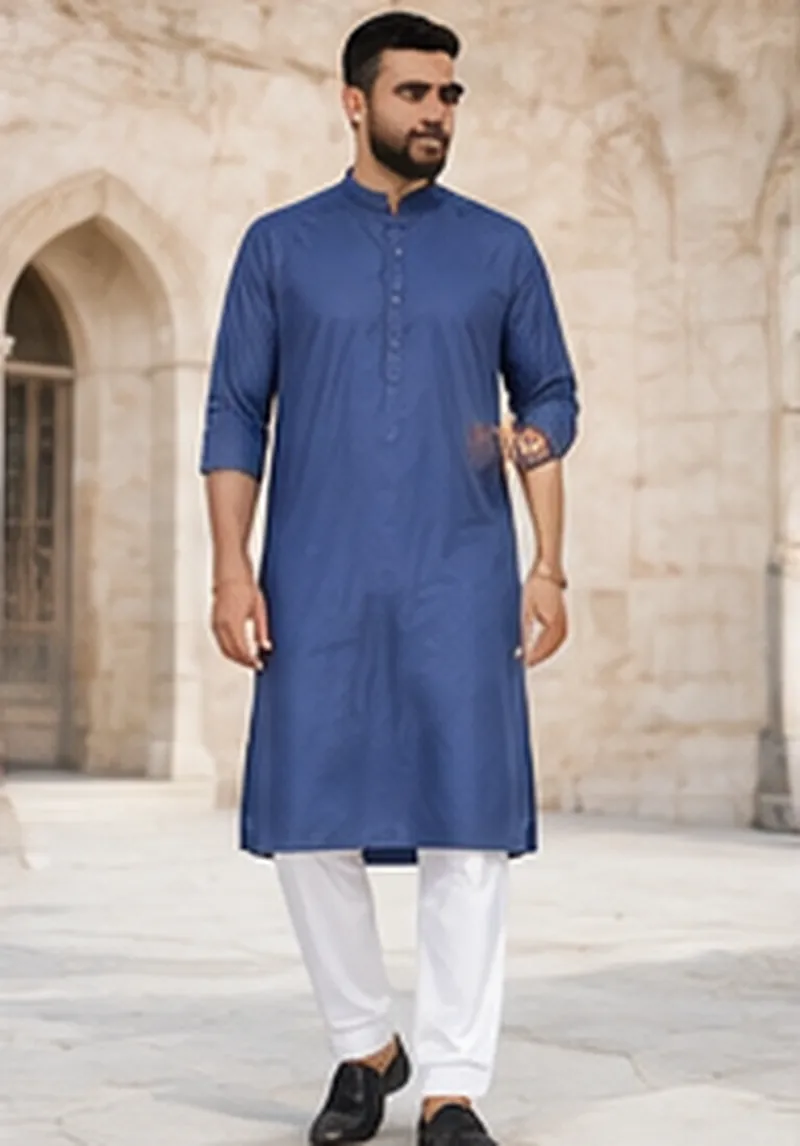
Kurta tunics for men and where they belong
The kurta is a long shirt without a fitted waist, worn throughout the Indian subcontinent and carried by emigrant communities across the world. In its most familiar form it has a round or band collar, a short placket with buttons, long sleeves and side seams that run straight down. Muslim men wear it as everyday clothing, for Friday prayer and for Eid, often in plain cotton.
It is sometimes confused with the thobe or qamis of the Arab world, but this South Asian tunic differs in cut, with a shorter placket, side slits and often a more relaxed hem. It fits naturally into the wider family of long tunics, which also includes the gandoura and the shalwar kameez.
Historically, the kurta evolved in a region of heat, dust and long distances, which explains its loose body and breathable fabrics. Muslim, Hindu and Sikh men have worn closely related versions for centuries, so the garment belongs to the shared dress of the subcontinent as much as to any single community.
Straight, side-slit and Pathani kurta cuts
A straight kurta has seams running from armpit to hem and is the simplest form. A side-slit kurta has openings at the hem so that the legs can move freely and the tunic does not ride up when sitting. A Pathani kurta, associated with Pashtun dress in Pakistan and Afghanistan, is longer and fuller, with a collar and chest pockets, and is worn with a matching shalwar.
Other variations exist. An angrakha style overlaps at the chest and ties at the side, and a kurta with a contrasting yoke carries decoration at the shoulders. Shorter kurtas, sometimes called kurti when cut for women, reach the hip, while a sherwani is a longer, structured coat for formal events.
Understanding these kurta cuts helps when ordering from a tailor. Specify the type of collar, the length, the presence of slits and the cut of the sleeve to avoid receiving a garment that is too fitted or too short.
Length and proportion of the long kurta
A long kurta usually falls somewhere between mid-thigh and mid-calf. A knee-length kurta pairs with straight or slim trousers, while a calf-length one suits wide shalwar and looks stately. Short kurtas that end at the hip are more casual and are often worn with jeans, though they are less formal.
Proportion matters. If the kurta is long and loose, the trousers should be plain and not too wide, so that the figure does not look overwhelmed. If the kurta is fitted at the chest, enough room at the hem allows free movement.
On length and its religious significance, scholars hold differing views about how far garments should descend, and families follow their own customs. A qualified scholar in your tradition can advise on your own practice.
Sleeve length deserves a thought as well. A full-length sleeve with a simple cuff is standard, while a short-sleeved long kurta is a summer version seen in hot cities. Fold-back cuffs let the wearer push the sleeve above the wrist for ablution without wetting the fabric.
Fabrics for kurta tunics, from khadi to silk
Cotton is the staple for kurta tunics, valued for breathability and ease of washing. Khadi, hand-spun and hand-woven cotton, is prized for its texture. Linen kurtas are cool and crisp. Silk and silk blends are worn on festive occasions, while wool and wool-blend kurtas give warmth in northern winters.
- Cotton lawn and voile: light fabrics for summer.
- Khadi and handloom cotton: textured and durable, loved for everyday wear.
- Linen and linen blends: cool, but wrinkle easily.
- Silk and raw silk: dressy, with a subtle sheen for weddings and Eid.
- Wool blends: for winter, often worn under a jacket or waistcoat.
Many embroidered kurtas use chikan, a delicate white-on-white thread work associated with Lucknow, or mirror work and zari thread for festive wear.
Weight is measured by feel: hold a swatch to the light and drape it over your hand. A kurta in fine cotton lawn will fall softly, while one in dense khadi will stand away from the body and keep its shape.
Collars, buttons and embroidery
The mandarin or band collar is the most common, a short stand-up strip that sits flat against the neck. Some kurta tunics have no collar at all, with a simple keyhole opening. Buttons may be plain, covered or decorative, and loops and toggles are sometimes used for a traditional touch.
Embroidery usually sits along the placket, collar and cuffs. Tone-on-tone work is understated and suits daily wear, while contrasting thread and metallic accents are preferred for celebrations. Printed borders and block prints lend a casual character.
Check the stability of the neckline. A well-made placket is reinforced on the inside so that it does not stretch when buttoned and unbuttoned.
Contemporary designers add subtle details such as contrast piping on the placket, tipped cuffs or a printed lining visible when the sleeve is rolled. These are matters of taste, but a solid, well-cut garment will always outlast a fashionable trim.
Pairing a long kurta with trousers
The long kurta can be worn with churidar, narrow pants that gather at the ankle, with shalwar, a loose trouser gathered at the waist, with pyjama, a straight and plain pair, or with a lungi, dhoti or sarong in some regions. In the West many men wear their kurta with chinos, jeans or slim trousers, which gives a hybrid look.
For prayer, a kurta with loose trousers allows free movement, and the length should be checked for comfort in bowing and prostration. A waistcoat or Nehru jacket adds a formal layer for Eid or a wedding, and a sherwani is the choice for the groom's family.
Footwear ranges from leather sandals, such as the peshawari chappal, to loafers and mojari slippers.
Occasions and colours
White and cream are traditional for Friday and Eid in many communities, while pastels and earth tones are everyday favourites. Deep jewel tones such as maroon, bottle green and navy are chosen for weddings and receptions. Black and charcoal are common in cooler months.
Workplaces in South Asia often welcome the kurta as business wear, while in Europe and North America it is commonly worn at religious events, family gatherings and cultural festivals. Some men enjoy wearing a plain kurta on weekends because it is comfortable, forgiving and easy to layer. Choosing the men's kurta for the occasion is mostly a question of fabric weight and trim.
Buying, tailoring and caring for a kurta
Ready-to-wear long kurta designs are available in markets and online, while a local tailor can make one to measure in a few days. Provide measurements for chest, shoulder, sleeve and length, and bring your preferred trousers so the tailor can balance the proportions. Request seam allowance if you expect the cotton to shrink.
Wash cotton kurtas in cool or lukewarm water and let them dry on a hanger, then press while the cloth is faintly damp. Embroidered pieces should be turned inside out and pressed gently. Silk and heavily embroidered garments are better dry-cleaned, and a muslin bag protects them in storage.
When travelling, a kurta in a crease-resistant cotton blend packs flat and can be refreshed with steam. Take a spare so that you can wear a clean tunic to Friday prayer after a long journey.
Frequently asked questions
What is the difference between a kurta and a thobe?
A thobe is an ankle-length Arab robe with a collar, while a kurta is a South Asian tunic, often shorter, with side slits and a band collar. Both are loose, long garments worn by Muslim men.
What is a Pathani kurta?
A longer, fuller kurta with a collar and pockets, associated with Pashtun dress in Pakistan and Afghanistan, and usually worn with a matching shalwar. It is traditionally worn with a matching shalwar, a loose trouser, and often topped with a waistcoat or a woollen shawl in winter.
Which fabric is best for summer?
Light cotton, cotton voile and linen. They breathe and dry quickly, and a loose cut lets air circulate. Check the fabric against light if you want it fully opaque. A looser cut, with side slits, keeps the tunic from clinging when you walk in hot or humid weather.
How long should a kurta be for prayer?
Pick a hem length that lets you bow and prostrate without discomfort. Schools and communities hold varying views on length, so consult a knowledgeable teacher if you need direction. A knee-length tunic with loose trousers is a common compromise that allows easy movement, and a tailor can adjust the hem to your preference.