What Muslim clothing for men means in Australia
Muslim clothing for men in Australia is not a single uniform. It is the sum of choices made by men whose families come from Lebanon, Turkey, Afghanistan, Bosnia, Bangladesh, Pakistan, Indonesia, Somalia and many other places, together with those born in Australia and those who embraced Islam as adults. Each brings a different idea of what a respectable outfit looks like.
Nearly all Muslim men work from one general idea of decency: keep the area between navel and knees covered, choose garments that sit loosely, and stay away from dress that signals pride. Scholars and communities differ about the details, such as the length of trousers or whether certain fabrics are acceptable, so a man with a specific question is best served by asking a qualified scholar he trusts.
In practice, a large share of Muslim men in Australia dress exactly like their colleagues on weekdays, in work shirts, chinos or jeans, and keep the thobe, kurta or jubba for the mosque, for Eid and for family gatherings. Others wear traditional dress daily. Both approaches are common and neither is seen as more correct by the community at large.
Muslim men's clothing for sun, surf and southern seasons
Australian conditions shape what is comfortable. Summers in Sydney, Perth, Adelaide and Brisbane bring intense sunlight and heat, while Melbourne can swing through several seasons in one day and the inland north stays hot for much of the year. For Muslim clothing for men, light, loosely woven cotton, linen and voile let air move around the body and keep a long garment bearable.
Long loose sleeves and a full-length hem are a natural fit for the sun, a point Australians already know from the long-running Slip, Slop, Slap campaign run by cancer councils. A pale thobe with a cap or wide-brimmed hat gives real protection, and dark colours absorb more heat, so many men keep black and navy for cooler months.
Because Australia sits in the southern hemisphere, Ramadan moves through the seasons in an order that differs from Europe or North America. When it falls in the cool months, fasting days are shorter and heavier layers become useful for early dawn prayers; when it falls in summer, breathable fabrics matter far more than anything else.
Islamic menswear and the cultures behind it
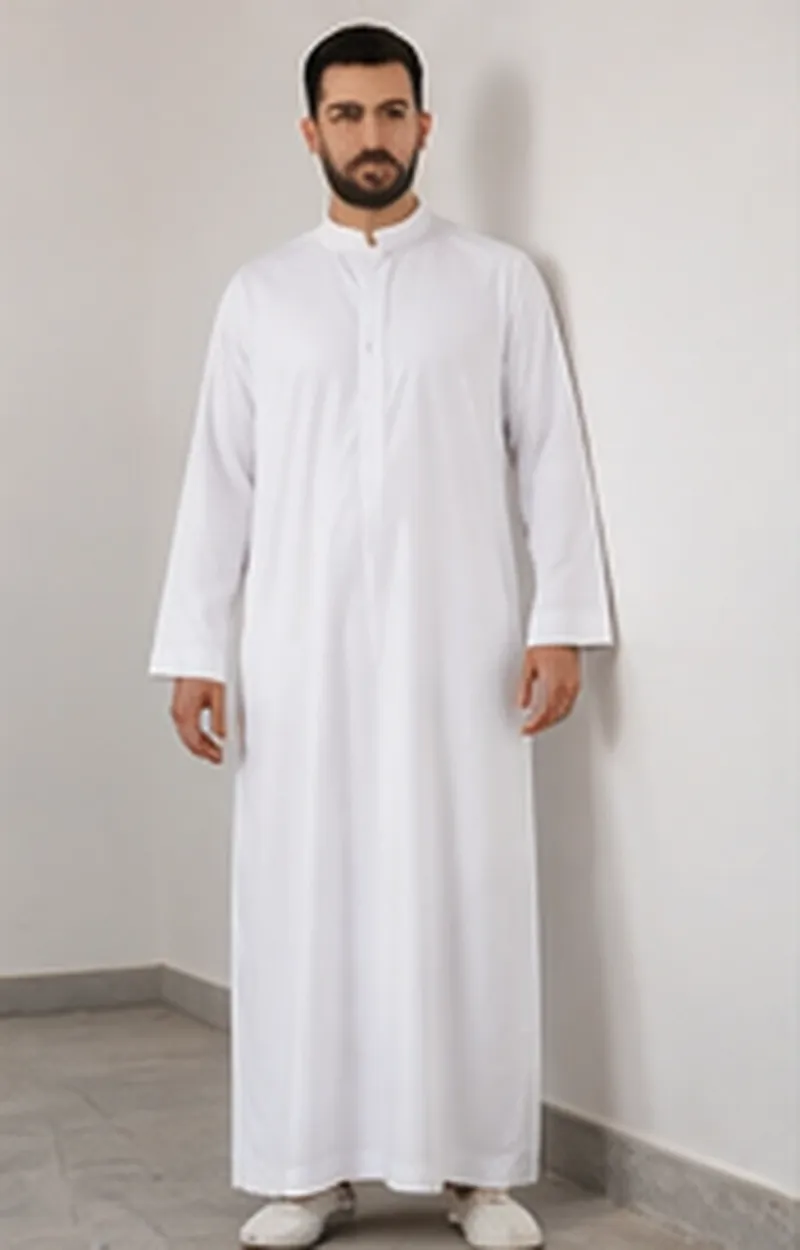
In halal menswear the garment most people picture first is the thobe, also called qamis, dishdasha or jubba depending on region. It is an ankle-length shirt-dress, often white in warm weather, with a mandarin collar or a simple round neckline. Gulf, Levantine and North African styles differ in cut, but all are easy to wear and quick to launder.
Families with South Asian roots bring the kurta and shalwar kameez, a long shirt paired with baggy trousers, which copes well with humid city weather and looks sharp at a wedding. Turkish and Balkan families often prefer tailored trousers and shirts with a plain knitted or crocheted cap for prayer, while Indonesian and Malay men may add a sarong and a songkok for religious occasions.
- Thobe or qamis: one-piece, ankle-length, popular for Friday prayer
- Kurta with pyjama trousers: breathable and common in South Asian homes
- Jubba or jellabiya: looser, often with a hood in cooler weather
- Sarong and songkok: typical for Southeast Asian community events
Many younger men mix these elements, pairing a short kurta with jeans or throwing a bomber jacket over a thobe, which reflects a distinctly Australian habit of relaxed, practical dressing.
Friday prayer, Eid and the working week
Friday prayer is the weekly moment when many men dress with extra care. Mosques in cities such as Sydney, Melbourne and Perth fill with a wide range of outfits, and no one is turned away for wearing ordinary clothes as long as they are clean and cover the required areas. A prayer cap is optional in most traditions and a matter of habit rather than obligation for many men.
Households buy new outfits in the weeks ahead of the two big celebrations: Eid al-Fitr, which closes Ramadan, and Eid al-Adha. In suburbs with large Muslim communities, such as the western Sydney area around Lakemba and Auburn, Eid prayers draw crowds in their best clothes and shops stay busy in the days leading up to the celebration.
For Muslim men's clothing on weekdays the challenge is logistics. Those who pray during the working or study day usually carry a folded cap, spare clean socks and a compact prayer mat, and wear trousers and shirts that cope with wet feet and forearms after a rapid wash before prayer. Short sleeves that ride up the arm are less convenient than sleeves that fold back easily.
Where to buy Islamic menswear in Australia
Haldon Street in Lakemba, in Sydney's southwest, is probably the best-known strip for Islamic clothing, with shops selling thobes, caps, prayer beads and fragrances alongside restaurants and bookstores. Similar clusters can be found in Auburn, in Melbourne's northern and south-eastern suburbs and in parts of Perth, Adelaide and Brisbane.
Online stores selling modest menswear have widened the choice considerably. Australian Muslim retailers ship across the country, and many men also order from sellers in Malaysia, Pakistan, Turkey and the Gulf. Delivery from overseas can take weeks and sizing varies between countries, so measuring a shoulder width and length against a garment you already own is a sensible step before ordering.
Local tailors are another option, especially for weddings and Eid. A tailor can adjust sleeve length, add deeper pockets or lengthen a hem, and can often work with fabric brought from overseas. Asking to see a finished garment before committing helps avoid surprises.
Rights at work and in the shop
Australian law protects people from certain kinds of discrimination, including on the basis of religion in some states and territories, and federal bodies such as the Australian Human Rights Commission accept complaints about unlawful treatment. Employers can set reasonable uniform and safety requirements, and what counts as reasonable depends on the job and the facts, so a man worried about a dress code can ask his employer for a conversation first.
Safety rules shape Islamic menswear for tradesmen, mine workers and food handlers: loose long garments near machinery, for example, may be a genuine hazard, so a fitted work shirt on site and a thobe afterwards is a pragmatic compromise. Employers are often open to practical adjustments when asked politely.
Anyone buying in Australia has rights under the national Australian Consumer Law, which the Australian Competition and Consumer Commission supervises. Goods must be of acceptable quality and match their description, which includes online listings. This is general information only and not legal advice for any specific dispute.
Building a modest menswear wardrobe
A practical starting set of Muslim clothing for men for a man in Australia might be two white or light thobes for summer prayer, one darker thobe or jubba for cooler months, a couple of kurtas for informal use and a handful of plain caps. Add loose-fit trousers and long-sleeved cotton shirts for work, and the wardrobe already covers most situations.
Quality shows in details rather than price tags: even stitching at the collar and side seams, a hem that is not too tight around the ankles, and fabric that does not turn see-through under bright light. Holding a garment against a window is a quick test for opacity, and white cotton should be lined or double-layered if it looks thin.
Care for Islamic menswear is simple. Cotton and linen thobes can usually be washed cold and line-dried in the Australian sun, which also freshens the fabric. Hanging them promptly avoids creases, and a light steaming before Friday prayer is usually enough.
Frequently asked questions
What do Muslim men usually wear in Australian summers?
Most choose light cotton or linen thobes, kurtas or loose shirts in pale colours, often with a cap or hat for sun protection. Breathable fabrics and loose cuts matter more than any particular style, and many men simply wear ordinary summer clothing that covers the required areas.
Is a thobe compulsory for Muslim men?
No. Islam asks for modest, clean clothing, but it does not prescribe one garment. Muslim men wear thobes, kurtas, shalwar kameez and plain shirts with trousers alike, and opinions on finer points vary, so a qualified scholar is the right person for precise questions.
Where can I buy Islamic menswear in Sydney?
Haldon Street in Lakemba is the best-known area, and Auburn also has several shops. Many Australian retailers sell online as well, which helps if you live outside the main cities, though checking sizes against a garment you own is wise.
Can my employer stop me wearing religious dress?
Employers may set reasonable uniform and safety rules, but discrimination on religious grounds can be unlawful in many circumstances. The answer depends on the job, the state and the facts, so speak to your employer first and seek independent legal advice if needed.