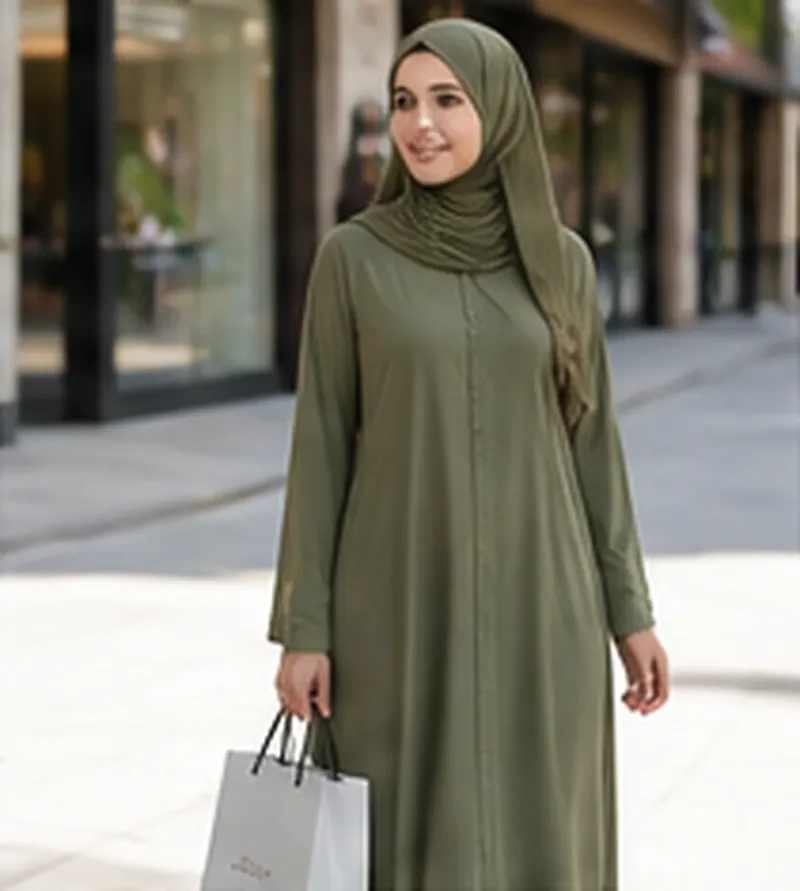
Muslim clothing for women in a long-established community
Muslim clothing for women throughout Britain carries the imprint of more than a hundred years of settlement and repeated waves of arrivals. Families with roots in Pakistan, Bangladesh, India, Somalia, Yemen, Nigeria, Iraq, Turkey and the Arab world now include British-born third and fourth generations, together with converts. The result is a market where a Gujarati salwar, a Gulf abaya and a tailored blazer with a jersey scarf all count as everyday outfits.
Islamic dress for women rests on modesty, commonly taken to mean flowing, non-see-through clothing and, for many, a head covering. Others do not cover their hair, and scholars have offered a range of views on specifics. A woman's way of dressing is a personal and sometimes family decision, and questions about religious rulings are best directed to a scholar she trusts.
British styles are known for combination. Many women pair a hijab with a trench coat, a long cardigan or a denim jacket, and the same person might wear a shalwar kameez at a family event and a maxi dress with leggings for work.
Modest fashion for Muslim women: from high street to runway
Modest fashion has become a notable part of British retail. Major high-street chains sell long skirts, wide-leg trousers, longline blazers and maxi dresses that suit modest wear, and several have launched dedicated ranges at Ramadan and Eid. Muslim designers and bloggers based in London, Birmingham, Manchester and Bradford have built businesses that sell worldwide.
Modest fashion events and showcases have become a regular feature of the calendar in London and other cities, where designers present abayas, scarves and occasion wear alongside mainstream brands. Social media has played a large part, with creators sharing styling tips for office, university and travel.
- Longline blazer and wide trousers with a jersey hijab for interviews
- Pleated midi skirt with a high-neck knit for autumn
- Open abaya over a printed dress for summer weddings
- Waterproof trench with a wool scarf for commuting
Dressing Muslim women's clothing for drizzle, tube journeys and long summer days
British weather asks for flexibility. Rain is possible in every month, temperatures are mostly mild, and a few heat waves in summer test the loose layers that suit modest dress. Cotton jersey, viscose and linen blends are common choices, with a light waterproof jacket stored in a bag.
Commuting shapes clothing too, and even a long coat has to pass the test of a packed platform in the rush hour, when there is hardly room to adjust a sleeve. Crowded trains and buses reward hems that do not trail and scarves that stay in place without constant adjustment, and many women favour neat, pinned styles or ready-to-wear hijabs. Shoes that cope with long walks and wet pavements are the third pillar of a commuting wardrobe.
Ramadan sometimes falls in the long days of summer, and the fasting hours can be extensive. Women then lean towards breathable fabrics and light colours, while evening prayers at the mosque call for a comfortable prayer dress or a two-piece set.
Uniforms, workplaces and the Equality Act
The Equality Act 2010 protects people from discrimination on grounds that include religion or belief, and the Equality and Human Rights Commission provides guidance. Employers can lawfully set dress codes for legitimate reasons such as safety or hygiene, but they must avoid treating religious dress unfairly. Advisory, Conciliation and Arbitration Service guidance helps both sides discuss workplace questions.
School uniform in England is largely set by individual schools, and many accommodate the hijab in school colours. The question of religious dress in schools reached the House of Lords in the case of Begum in 2006, where the court upheld the school's uniform policy on the facts, an example of how outcomes depend on the policy and its justification. Guidance varies in Scotland, Wales and Northern Ireland.
These notes are a general guide and do not replace legal advice. A woman who faces a dispute can contact an advice service, a union or a solicitor.
Where British Muslim women find modest fashion
Traditional shopping streets still matter for Muslim clothing for women, and a morning in one of them is a social outing as much as an errand. In Birmingham, Ladypool Road and Stratford Road in Sparkhill have fabric shops, bridal boutiques and abaya stores. In London, Whitechapel Road, Brick Lane, Edgware Road and Green Street have long served communities with scarves, jilbabs and occasion wear, while Southall Broadway, Manchester's Cheetham Hill and Rusholme and Bradford's Manningham Lane offer similar variety.
Online retail of modest wear is substantial. British Muslim brands ship across the country with next-day options, and international sellers add Turkish, Malaysian and Gulf styles. The Consumer Rights Act 2015 sets out that goods should be of satisfactory quality and as described, and local Trading Standards offices and the Competition and Markets Authority provide guidance on consumer matters.
Dressmakers and tailors make bespoke modest fashion for Muslim women. Many women commission outfits for weddings, graduations and Eid, supplying fabric from trips abroad, and a good tailor can transform a high-street dress into something modest with sleeves, lining and extra length.
Weddings, Eid and graduation days
Occasions are the great showcase for Muslim women's clothing in Britain. Eid mornings bring families to mosques and halls in new abayas, embroidered shalwar kameez, Somali dirac or Turkish coats, and a spring or autumn Eid can mean a smart coat over the top.
Weddings often last several days, and the modest fashion for Muslim women on show is spectacular. Bangladeshi and Pakistani events feature heavily embroidered lehengas and gharara sets, Arab events favour beaded gowns and kaftans, and nikah ceremonies may call for restrained elegance. Guests commonly bring a pashmina or shawl to adapt a sleeveless dress to their preferences.
Graduation ceremonies add a special case that is hard to find in guides: a gown and mortarboard over a hijab and modest dress, with a scarf colour chosen to complement university robes. Planning the scarf ahead avoids last-minute stress.
Choosing fabrics and caring for them
Fabric labels reward attention when buying Islamic women's clothing. Chiffon and georgette drape beautifully but are often sheer, so a camisole or inner layer is wise. Cotton jersey is forgiving and washes well, while crinkle viscose avoids ironing. For winter, a wool scarf or pashmina adds warmth without bulk.
Before paying, check that sleeves cover the wrist when arms are raised and that skirts do not ride up when sitting. A garment tried in natural light shows opacity honestly, and one that is comfortable when moving is more likely to be worn.
Washing and care of Muslim women's clothing are simple but important. Delicate scarves can be washed by hand and dried flat, magnets and pins should be removed beforehand, and abayas can be hung in the bathroom while showering to release creases.
Frequently asked questions
Which clothes are typical for Muslim women in Britain?
Styles vary widely, from hijabs with abayas, long dresses and trousers to shalwar kameez and ordinary high-street clothing worn modestly. Some women wear a face veil, and some do not cover their hair. Each decides according to her understanding.
Can a school ban a hijab in the UK?
Uniform rules differ from school to school, and a good number accept a hijab in the school's colours. Courts have judged cases on their facts, so outcomes depend on the policy and the reasons given. Parents can ask the school and seek advice if worried.
Where can I buy abayas in Birmingham or London?
Ladypool Road and Stratford Road in Birmingham, and Whitechapel Road, Edgware Road and Green Street in London are well known for abayas, scarves and occasion wear. Many UK Muslim brands also sell online with fast delivery.
Does the Equality Act cover religious dress?
The Equality Act 2010 prohibits discrimination because of religion or belief, which can include dress linked to faith. Employers may set legitimate requirements, so the answer depends on circumstances. The Equality and Human Rights Commission offers guidance.