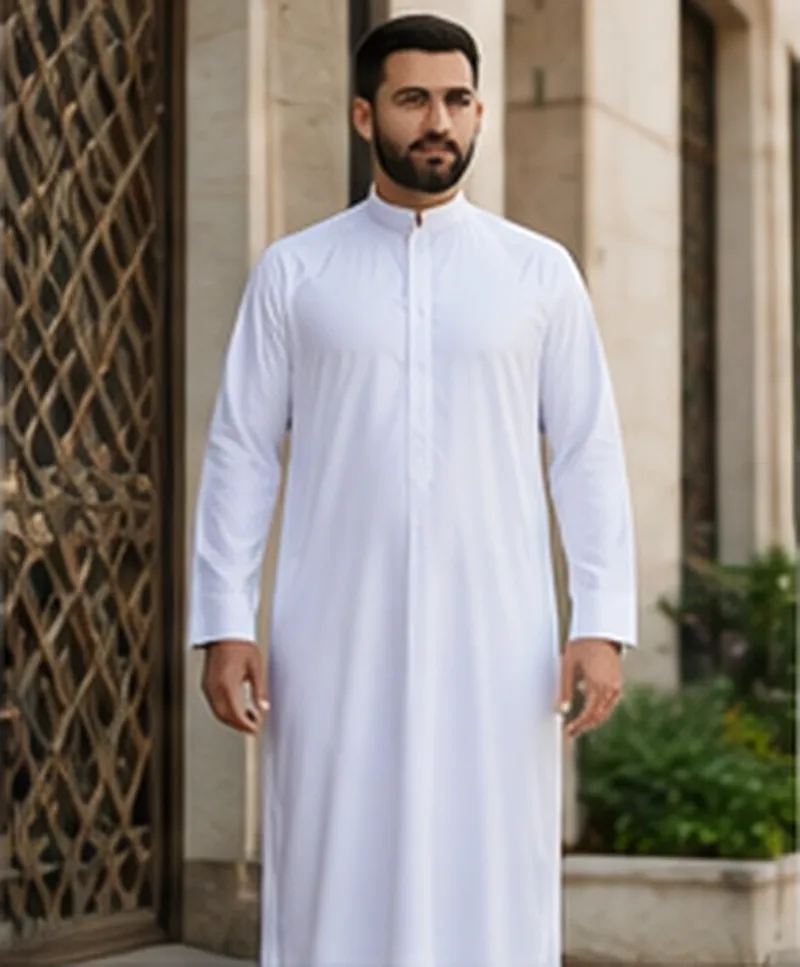
What halal clothing for men includes
Halal clothing for men is a loose phrase rather than a legal category. It describes garments worn by Muslim men that follow the broad principles of covering the body suitably, avoiding clothing that is excessively tight or revealing, and dressing with dignity. Many scholars hold that a man should cover at least the area between the navel and the knee, though opinions on details differ.
In practice this covers a huge variety, from the long white thobe of the Arabian Peninsula to a plain shirt and straight trousers bought in a high street shop. The same man may wear a thobe on Friday and a business suit on Monday.
Since dress is shaped by local culture as much as by religious teaching, Muslim menswear in Senegal looks quite different from that in Malaysia or Bosnia. The common thread is a preference for looseness and sobriety.
A man choosing what to wear usually weighs three things at once: the demands of his job or studies, the climate, and the expectations of his family and community. Halal clothing for men is therefore best seen as a set of reasonable choices rather than a rigid list.
The thobe and other Islamic menswear from the Arab world
The thobe, also called thawb, dishdasha, kandura or jalabiya depending on region, is a long, ankle-length garment with sleeves. Gulf versions tend to be white, simple and cut with a mandarin collar or a small tab, while Sudanese and Egyptian versions often have a broader cut and a rounder neckline.
The Moroccan djellaba is a hooded, long-sleeved robe usually in wool or cotton, and the West African boubou or grand boubou is a wide, flowing, often embroidered robe. Each is cut to its climate and customs.
A thobe is typically worn with sandals or dress shoes, sometimes with a headcover such as the ghutra and agal in the Gulf, or a simple cap. In colder weather a cloak called a bisht or a woollen overcoat is added. These garments are the best-known Islamic menswear in international shops.
Kurtas, shalwar kameez and South and Southeast Asian styles
The kurta is a knee-length or longer tunic worn over loose trousers or a wrapped garment. In Pakistan and northern India, the shalwar kameez pairs a long shirt with baggy trousers gathered at the ankle, and is appropriate for everyday wear, prayers and weddings.
In Indonesia and Malaysia, men wear the baju Melayu, a loose shirt with matching trousers, often with a sarong wrapped around the waist and a songkok cap. In Bangladesh a panjabi worn with pyjama trousers or a lungi is popular.
These garments adapt easily to hot, humid weather. Cotton and lightweight blends dominate, and embroidery or collar details distinguish formal pieces from daily wear.
Regional footwear and headwear complete these outfits. Leather sandals, embroidered caps and woven prayer caps in white or colours accompany the kurta, and turbans are worn by some men on special days, with styles varying by community.
Contemporary Muslim menswear in the West
Many Muslim men in Europe and North America wear conventional clothes: shirts, chinos, jeans, jackets and suits. Choosing straight or relaxed cuts rather than skin-tight styles, and trousers that sit comfortably at the waist, meets the preference for modesty while remaining unremarkable at work.
Long shirts and tunics have become popular as everyday wear, often with slim trousers. Some brands design kurta-style jackets or longline shirts that look contemporary yet traditional. A knitted kufi cap or a plain beanie is a simple addition for those who wish to cover the head.
- Straight or relaxed trousers that sit at the waist
- Long-sleeved shirts or longline tunics
- Overshirts and long coats for cold weather
- Caps such as the kufi or taqiyah for those who wish to wear one
Younger men often follow streetwear trends, adopting oversized shirts, long hoodies and wide trousers that conveniently meet preferences for looseness. Muslim menswear brands increasingly adapt such designs with longer hems and thicker fabrics.
Fabrics, colours and fit in men's modest clothing
Cotton, linen and light wool dominate because they breathe and wash easily. Poly-cotton blends are common for thobes, as they resist creasing and keep their whiteness. Heavier fabrics such as wool or brushed cotton are used in winter.
White is widely worn in hot climates for its reflectiveness and tradition, but cream, grey, navy, brown and olive thobes are available. Colours and details vary by region, and many men have different thobes for work, prayer and celebrations.
For fit, the shoulder seam should rest at the shoulder and the sleeve should end at the wrist. Hem lengths vary: some men prefer garments to end above the ankle, a practice many connect with a saying attributed to the Prophet, while others wear them longer. Opinions differ, and a qualified scholar can advise.
Pay attention to sheerness in white cotton. Hold the cloth to the light, and consider a double layer across the chest and back. Halal clothing for men in thin summer fabrics can otherwise become see-through when damp from sweat.
Dressing for prayer, work and festivals
For prayer, clean, loose garments that allow bowing and prostration are the main requirement. Many men keep a thobe or a long shirt at the mosque or office for Friday prayers, and wear a cap if they choose to.
At work, practical modest dress usually means long-sleeved shirts, tailored trousers and a jacket. Uniform policies in some professions can affect the choice, and employers are often willing to discuss reasonable adjustments. Muslim menswear for the workplace is mostly understated.
For Eid and weddings, men often choose new thobes, embroidered kurtas, sherwanis or waistcoats. Colours and fabric become richer, but the cut remains loose. Perfume and a neat cap or turban complete the festive look.
Travelling to the Hajj or Umrah brings special garments for men, the two unstitched white cloths of ihram, which differ from daily wear and are governed by their own rules. Pilgrims should follow the guidance of their group leader or a qualified scholar.
Buying and caring for menswear
Before buying a thobe or kurta, check the neck and sleeve measurement, the length from shoulder to hem and the chest width. Sizing varies widely between makers, so rely on the measurements rather than the label.
Look at the stitching on collars, cuffs and side seams, and examine whether the fabric is opaque in bright light. White garments in thin cloth can show the outline of underclothes, so choose a good weight or wear a slip.
To care for white garments, wash separately in cool or warm water, avoid mixing with dark colours and hang to dry in shade. Iron while slightly damp, and store folded or on wide hangers to keep their shape.
Tailors in many cities make thobes and kurtas to measure at reasonable prices, and ready-made garments can be hemmed. A good fit improves comfort and lengthens the life of Muslim menswear considerably.
Everyday habits and wardrobe planning
A compact wardrobe suffices for most men: two or three thobes or long shirts for prayers and weekends, several plain shirts, two pairs of straight trousers, a coat for winter and a pair of comfortable shoes. Rotating these keeps them fresh and extends their lives. Halal clothing for men works best when every piece has several uses.
Keep things simple when travelling. A lightweight kurta, a pair of loose trousers and a scarf serve for prayer, sightseeing and cool evenings, and pack down small in a carry-on bag.
Seasonal buying pays off. Cotton garments are cheaper at the end of summer, and winter coats are reduced in spring, so planning purchases around sales helps keep Islamic menswear affordable.
Frequently asked questions
Do Muslim men have to wear a thobe?
No. A thobe is a traditional garment in many regions, but there is no obligation to wear it. Men may wear shirts, trousers, kurtas or suits, provided they choose clothing that covers suitably and matches their own understanding of modesty.
What is the difference between a thobe and a kurta?
A thobe is usually an ankle-length robe from the Arabian region with a plain or mandarin collar, while a kurta is a shorter tunic from South Asia worn over trousers. Both are loose and comfortable for hot weather.
Can men wear shorts?
Many scholars regard the area from the navel to the knee as the minimum for men to cover, so knee-length shorts meet this view. Others prefer longer garments for a variety of reasons. A qualified scholar in your community can guide you.
How do I keep a white thobe looking fresh?
Wash it separately, choose gentle detergent, avoid harsh bleach and dry it in shade. Treat stains quickly, iron while slightly damp and store on a wide hanger so the shoulders hold their shape.