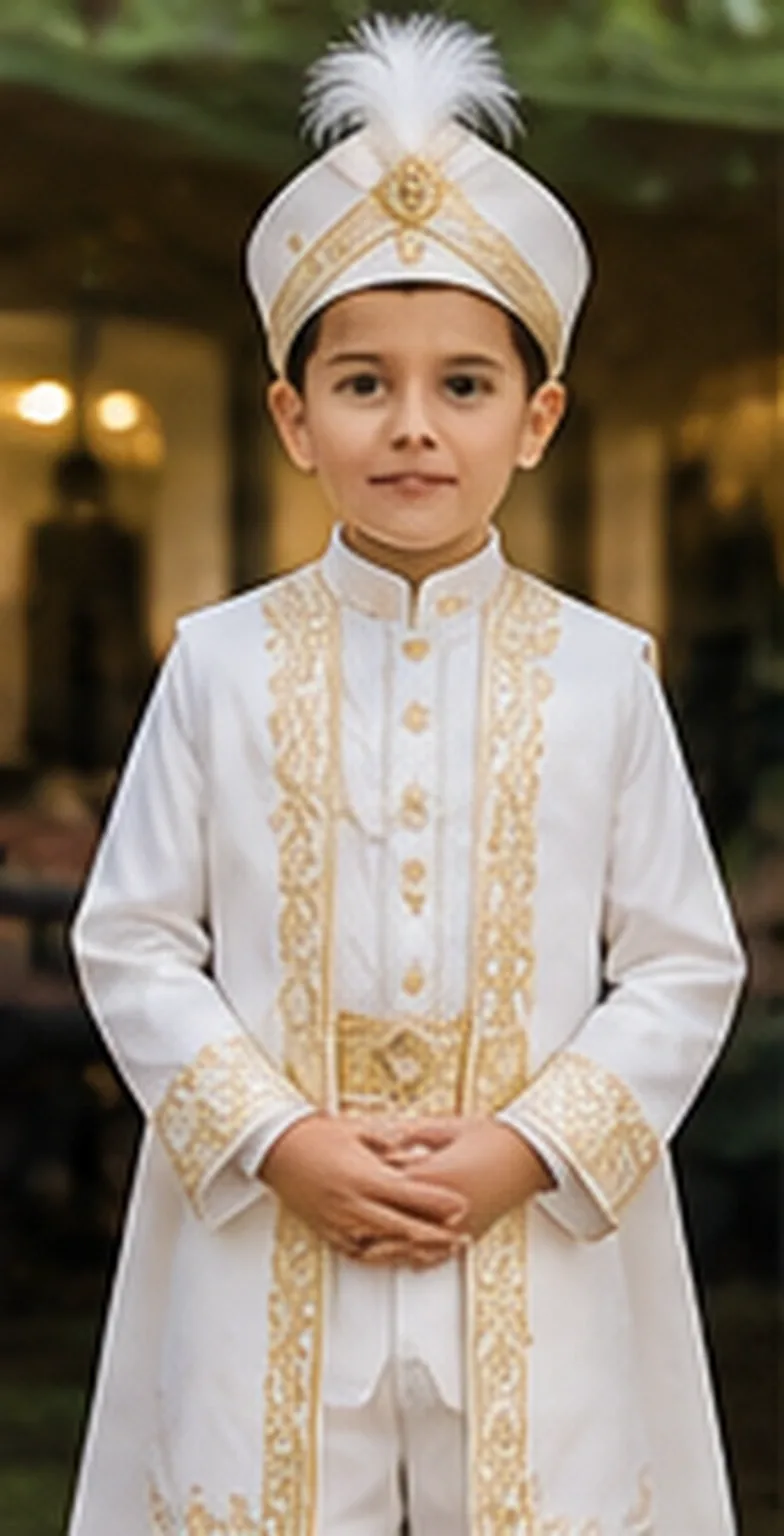
What a circumcision outfit is
A circumcision outfit is a special costume prepared for a boy around the time of his khitan, the circumcision that is widely practised among Muslims. In many cultures the procedure marks the child's step toward the responsibilities of the faith, so the family treats the day as a celebration and dresses him like a young prince, with a decorated cloak, a hat and sometimes a ceremonial staff.
Whether the practice behind the circumcision outfit is considered a recommended practice or an obligation is described a little differently by the major schools of jurisprudence, and families follow the teaching of their own community. What the clothing expresses is not a religious requirement but a custom of joy, hospitality and pride shared with relatives.
The outfit is usually worn for the gathering and for photographs, while something loose and comfortable is chosen for the hours when the boy is at medical appointments or recovering.
Old photographs in many homes show fathers and grandfathers in similar clothes, and a younger brother may be given the same set a few years later. That sense of continuity is much of the charm.
Turkish sunnet dress and its cape
In Turkey the boy's celebration, the sünnet düğünü, has produced one of the most recognisable circumcision clothes. The classic set consists of a white or cream satin suit, a long cape lined in a contrasting colour, a sash across the chest and a cap or crown-like hat embroidered with the word Maşallah, an expression of wonder and protection.
Sequins, gold braid and tassels are common, and many boys also carry a short sceptre. Families sometimes rent the costume from a specialist shop rather than buying it, because it is worn only once and can be expensive to tailor.
Neighbours and relatives traditionally give gifts of money or gold, which are sometimes pinned to the sash, so a strong fabric and a firm band matter more than they might appear.
Shoes are usually dark or white and kept simple. Boys often kick off patent leather quickly, so soft soles are a sensible choice, and white socks should be packed in case of rain on the way to the venue.
Circumcision clothes across other regions: robes, turbans, tunics
Elsewhere the circumcision ceremony outfit follows local dress, and the circumcision clothes chosen reflect the region. In Morocco the boy may wear a white djellaba and a red fez or a pale cap, sometimes with an embroidered waistcoat, and may be carried on a decorated seat or a horse in a procession. In Egypt and the Levant a long galabiya or thobe, often in white, serves as the base garment.
In Pakistan, India and Bangladesh the tradition leans toward a sherwani or an embroidered kurta with churidar trousers, with a cap or turban in matching silk. For the sunatan celebration, boys in Indonesia and Malaysia frequently put on a baju Koko or baju Melayu topped with a songkok, whereas families in Central Asia have dressed the boy in a striped chapan and a skullcap for the feast.
- Turkey: satin suit, cape, sash and embroidered cap.
- Morocco: djellaba, fez or cap and decorated waistcoat.
- South Asia: sherwani or kurta with a turban or cap.
- Southeast Asia: baju Melayu or Koko with a songkok.
- Central Asia: chapan robe with a tubeteika skullcap.
Colours, fabrics and decoration of the circumcision outfit
White is the most common base because it symbolises purity in many traditions, and gold, silver and royal blue are favoured accents. Fabrics are chosen for sheen and drape: satin, brocade, silk-like polyester, velvet for winter celebrations and fine cotton for hot climates. A lining of soft cotton prevents irritation on a tender body.
Decoration should be firmly stitched. On any piece of khitan clothing, sequins that shed and loose threads are a problem when a boy is excited and running around. Keep cords and tassels short and avoid anything that tightens around the neck.
The question of silk for boys comes up. Some scholars restrict silk to women, and others treat young children differently, so views vary; those for whom it matters can ask a scholar they trust. Many families simply choose satin made from synthetic fibres, which gives the same look.
Comfort and recovery: khitan clothing after the day
The day itself is only one part of the picture. After the procedure the boy needs loose clothing that does not rub, and many families choose a long cotton shirt or a wide wrap and gown for the first days. Specific care instructions must come from the doctor or practitioner who performs the circumcision, and they should be followed rather than guessed.
For the party it is wise to bring a second, lighter outfit besides the main circumcision outfit. A boy may be tired, anxious or sore, and a heavy costume with a cape can become a burden after an hour. Photographs can be taken first and a comfortable thobe put on afterwards.
Choose washable fabrics where you can and keep spare underwear and trousers in a bag, as nervous children are often more likely to have accidents.
Timing, size and ordering
Customs differ on age. Some communities circumcise in the first weeks of life, while others hold the celebration when the boy is a young child, and the outfit must be sized accordingly. Order the circumcision outfit early enough for a fitting, and leave a margin for growth because a boy can grow noticeably between measurement and the day itself.
A tailor can adjust a ready-made robe quickly, and many boutiques offer made-to-measure service for a small group of sizes. Check the return terms for special occasion clothing, since refunds are often limited when an item has been worn.
If you live far from the country of your family, you may import a robe from a relative; plan around customs and shipping times so it arrives before the invitations go out.
A good rule is to try the circumcision outfit on at home, with the shoes and the cap, at least a week before the event. Raise the arms, sit down and walk up a few stairs: if anything pulls or slips, the tailor still has time to correct it.
Reusing, renting and keeping the memory
Because circumcision clothes have a single use, many families rent it or borrow one from a cousin. Renting is common for the Turkish cape set and for sherwanis in South Asia, and it is a perfectly respectable option. Return it with the accessories complete and clean, as agreed with the shop.
Others keep the outfit as a memento. Wrap it in acid-free tissue, add a cotton bag and avoid hanging heavy embroidery, which stretches the shoulders. A framed cap or a photograph beside the folded robe becomes a family treasure.
However it is acquired, the circumcision outfit works best when it reflects the family's own heritage, such as a regional embroidery pattern, rather than a copy of a costume that means nothing to the boy.
Frequently asked questions
What does a boy wear for a circumcision celebration?
It depends on the family's culture: a satin suit and cape in Turkey, a djellaba and fez in Morocco, a sherwani in South Asia or a baju Melayu in Southeast Asia. White and gold are widely used.
Is a special outfit required by religion?
No. The outfit is a cultural custom, not a religious requirement. Families dress the boy festively to mark the occasion, but a simple clean thobe or shirt and trousers is equally acceptable.
Should the boy wear the costume during recovery?
Usually not for long. Loose, soft cotton clothing is more comfortable afterwards, and you should follow the instructions of the doctor who performed the procedure. Keep the circumcision outfit for the gathering and photographs.
Can I rent a circumcision outfit instead of buying one?
Yes, renting is common, particularly in Turkey and South Asia, because the outfit is worn once. Ask what is included, how cleaning is handled and what happens if the item is damaged.