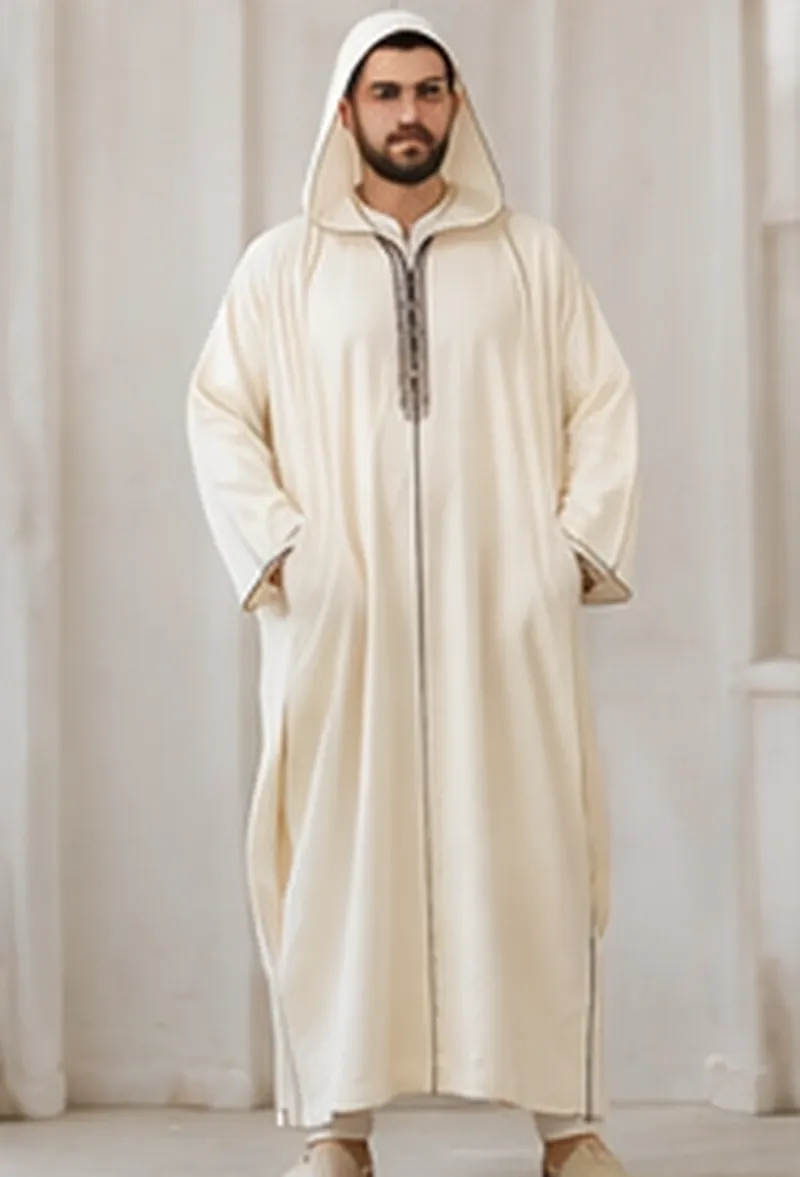
The hooded djellaba and its construction
A hooded djellaba is cut from wide panels of cloth that fall from the shoulders to the ankle, with a seam down each side and generous sleeves. At the back of the neck sits the hood, called a qob, a pointed shape that can be lifted over the head in rain, wind or cold, or left hanging between the shoulders. The front usually has a short opening closed with buttons, loops or knotted passementerie, and a pocket slit at each side.
The proportions are what make it distinctive. Unlike a straight robe, it hangs from the shoulders in a way that leaves space for layers beneath, and the hood gives it a recognisable outline. It is a practical garment first, shaped by a climate of hot days and cool evenings, and an elegant one second.
Compared with a men's djellaba made for the city, a mountain version tends to have a deeper hood, thicker wool and a wider cut so that layers can be worn underneath. A Moroccan djellaba made for summer, on the other hand, may be cut shorter in the sleeve and almost transparent in weight.
Moroccan djellaba styles by region and occasion
In Morocco, tailors recognise different types according to the region and the use. A plain wool hooded djellaba in a neutral tone is the everyday choice for older men and for winter. A lightweight cotton or linen version, sometimes with fine stripes, is worn in summer. A finer version with discreet embroidery or braid is kept for Friday prayer, weddings and festivals.
Neighbouring countries have their own relatives of the robe, such as the Algerian burnous, a hooded cloak, and the gandoura, a lighter tunic. Within Morocco itself, northern cities, mountain regions and desert communities each have their own cut and colour preferences.
Because the garment is so familiar, small signals matter: the quality of the cloth, the finish of the hood and the care of the trimmings tell people how formal the occasion is. Other djellaba robes are made for women, with different embroidery and colours, but the men's djellaba keeps to quieter tones.
Fabrics for each season
Wool is the classic fabric for a winter djellaba, thick enough to keep out cold in the Atlas mountains yet breathable. Blended wool is lighter and cheaper. Cotton and linen are chosen for spring and summer, while synthetic blends offer easy care but less breathability.
- Heavy wool: for cold winters and mountain climates.
- Fine wool or wool blends: for mild seasons and formal wear.
- Cotton: breathable everyday option, easy to wash.
- Linen: cool and crisp for warm weather, though it creases.
- Brushed or lined fabrics: extra warmth at the hood and shoulders.
Check the weight when buying. A good winter robe feels dense and falls straight, while a summer robe should be light enough to flutter as you walk.
Many tailors offer a lined hood so that the cloth does not itch the neck, and the lining of a hooded djellaba is often a lighter cotton in a matching shade. Ask for it if you plan to wear the robe daily in winter.
Embroidery, braid and buttons
Decoration is found mainly at the front opening, on the hood edge and at the cuffs. Sfifa, a flat braided trim, and aakad, small buttons made from knotted cord, are the traditional finishing touches. Hand embroidery with silk thread in tone-on-tone colours is a mark of quality.
Plain robes are valued as much as decorated ones, and the contrast in styles is deliberate: simple for daily life and prayer, richer for gatherings. Overly ornate trims can look out of place at the mosque, so many men choose restrained detail for everyday use.
Look at the stitching around the hood and front opening, since these areas take the most strain. A well-made piece has reinforced seams and neat finishing inside.
Buttons deserve attention too. A row of small cord buttons gives a traditional appearance, whereas a hidden zip simplifies dressing but changes the character of Moroccan djellaba tailoring.
Wearing the hood and the rest of the outfit
The hood is practical. In rain or cold, it covers the head and ears. In the sun, it shields the neck. In everyday settings it is often worn down, resting at the back. Some men wear a cap, a taqiyah, or a turban underneath.
Underneath the djellaba, men wear a shirt and trousers, or a lighter tunic. Yellow or white leather slippers, called babouches, are the traditional footwear. In winter, a scarf or a woollen cap adds warmth, and in the cities some men wear their djellaba over a suit.
A well-fitted robe allows free arm movement, so it is easy to lift the sleeves for ablution and to bow in prayer.
When travelling, a hooded djellaba is useful for cold coaches and airport lounges, as it doubles as a blanket. Roll it rather than fold it to avoid sharp creases in the wool.
Colours and meaning
White and cream are popular for Fridays and religious holidays, and for summer. Grey, brown and black dominate in winter, while beige and sand suit travel and daily wear. Bright colours are less common for men but can be found at weddings and in some regions.
A colour is not a code, and there is a great deal of personal choice. Still, families and communities often have shared expectations about what is appropriate for a mosque visit, a funeral or a celebration, and asking a relative or friend before a major event is a sensible step.
Seasonal change also shapes colour. As autumn arrives, lighter creams give way to oatmeal and brown shades, and by midwinter the darkest tones appear, matching the thicker cloth.
Modest dress, length and practice
The djellaba is loose and long, and many people value it for covering the body without restricting movement. Its length, usually to the ankle or just above, is a matter of tailoring and custom. Scholars hold different views on the exact length of men's garments, and a qualified scholar can answer questions about your own practice.
In cooler weather, the robe can be worn over other layers, while in warm weather it is worn over thin clothing. Because the hood adds weight at the neck, make sure the shoulders fit well so the robe does not slide back and pull at the collar. A sloping shoulder line, rather than a boxy one, helps the hood sit naturally.
Buying and looking after a hooded djellaba
Tailors in Moroccan cities make a djellaba to measure, and ready-made robes are sold in markets and online. Bring measurements for height, shoulders, sleeve length and chest, and decide how long the sleeve and the hood should be. Ask for a trial fitting before the final stitching.
Wool robes are best dry-cleaned or hand-washed in cool water. Cotton and linen robes can be machine washed in a gentle cycle. Hang the robe to dry out of direct sun and brush wool with a soft brush. Store with natural moth repellents, and keep the hood shape by stuffing it lightly with tissue paper.
If you buy a second-hand djellaba with a hood, check the underside of the hood and the armholes, where wear and moth damage often hide.
Frequently asked questions
What is the hood on a djellaba called?
It is called a qob in Moroccan Arabic. The pointed hood can be raised against rain and cold or left down at the back of the neck, and its shape is one of the robe's signature features.
Which fabric suits a Moroccan winter?
Wool or a thick wool blend, sometimes lined. It keeps out the cold while remaining breathable. For spring and summer, choose cotton or linen. Brushed wool or a lining at the hood adds comfort, and a hand-finished hem helps the robe keep its line when wet.
Can I wear a djellaba to the mosque?
Yes, it is a common choice for Friday prayer and festivals. Choose restrained embroidery and a clean, pressed robe, and follow the custom of your own community about the hood.
In what way does a burnous differ from a djellaba?
A djellaba is a robe with sleeves and a front opening, while a burnous is an open cloak with a hood that is worn over other clothes, especially in Algeria and Tunisia.