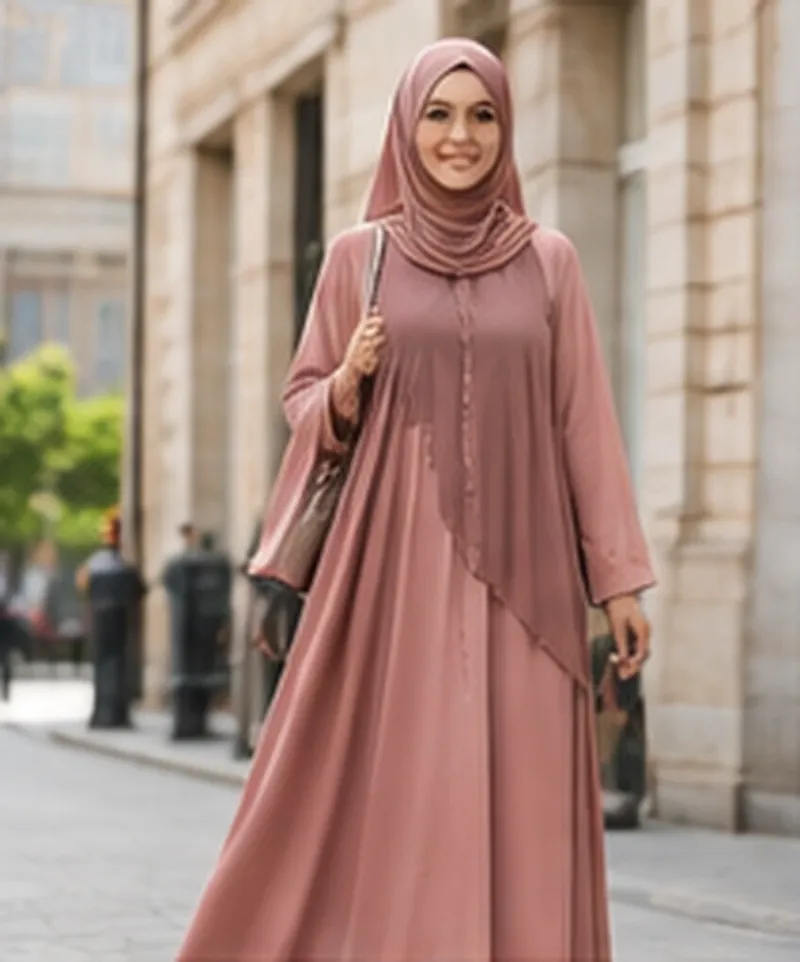
What long mastour tunics are
The word mastour is Arabic for covered or concealed, and in fashion it is used for long, loose tunics that give coverage over the body. They are cut wider than ordinary shirts, extend well below the hips, and often end at mid-thigh or the knee. They are worn with trousers, a long skirt or leggings beneath, which makes them a flexible alternative to a dress. Searching for long mastour tunics under different names, including covering tunic or long shirt, will reveal many more options than a single label.
Compared with a full-length abaya, a tunic is lighter and more informal, and compared with a regular blouse it gives far more coverage. For women who work, study or care for children, it is a practical choice because it allows movement and can be paired with a wide range of bottoms. Women who dislike wearing full-length robes often settle on modest tunics as their daily uniform, adding a scarf for the final layer.
Lengths and where they fall
Tunics are typically described by where the hem lands. A hip-length top suits those who prefer trousers and want slim lines. A mid-thigh length provides coverage for many women and is the commonest size for long mastour tunics. Knee-length tunics are close to a short dress and provide the most coverage, especially when worn over wide trousers or a long skirt. Always try the tunic with the shoes and bottoms you plan to wear, because a hem that looks long in a mirror can look much shorter when you sit.
Choose according to your height and the bottoms you plan to wear. A tall woman may find a knee-length tunic only just covers the thigh, while a short woman might find it hits the shin. Check the garment length against a favourite top to find your preferred proportion. For prayer, a longer tunic can also serve as the upper garment, with a skirt and scarf completing the set.
Side slits, necklines and sleeves
Side slits are a defining feature. They allow movement and help the tunic fall neatly over trousers, but slits that rise too high can reduce coverage when walking. A slit that stops at mid-thigh is common, and some tunics have no slits for a closed look. Closed hems pair best with narrow trousers and leggings. When a slit is higher than you like, a tailor can close it a few centimetres, a quick adjustment that does not change the garment's shape.
Necklines range from round and boat necks to shirt collars and mandarin collars. Plain, high necklines suit women who prefer more coverage, while wider necklines can be worn with an undershirt or a scarf. Sleeves can be long and straight, gathered at the wrist with elastic, or flared. Wrist-length sleeves with a slight cuff keep a tidy outline.
Fabrics for modest tunics
Cotton and cotton blends are the best all-round fabrics: breathable, easy to wash and gentle on skin. Linen suits hot weather but wrinkles. Viscose and rayon feel soft and drape well, though they can shrink if washed hot. Crepe resists creasing, and chiffon is used for lightweight overlays on festive tunics. Tunics in a polyester-cotton blend are a middle path, softer than pure synthetics and quicker to dry than pure cotton, which is useful during rainy seasons.
In winter, knit and brushed-cotton tunics provide warmth and look cosy over leggings. Check opacity, since light colours and thin cotton may reveal underlayers. A lined tunic hides the outline and falls more smoothly. Prints can help camouflage seams and creases. Wrinkle-resistant long tunic tops are a good option for travel, because they can be rolled and worn straight from the suitcase.
Tunic and trousers sets, and pairing options
A tunic and trousers set matches the top with wide-leg trousers or a straight skirt in the same fabric, forming a polished outfit with minimal effort. Co-ordinated sets are suitable for the office, for Eid visits and for travelling. They also come in cotton for summer and crepe for formal days.
If you buy separates, pair a tunic with straight or wide-leg trousers, a maxi skirt or palazzo pants. Leggings can work under a longer tunic but are usually worn with a top that covers the seat. Balanced proportions matter: a loose tunic with loose trousers can look shapeless, so some women add a belt or choose one part to be more fitted. A tunic and trousers set also reduces the need to match colours each morning, which many women appreciate on busy days.
Layered tunics for different seasons
Layered tunics use a longer, plain inner tunic with a lighter overlay, such as lace, chiffon or sheer embroidery. They give richness while keeping coverage, and they also serve as a statement piece for celebrations. Women often wear a long cardigan, vest or open abaya over a tunic to adapt to cold weather. Layered tunics in muted shades are discreet enough for office wear, while sparkle and embroidery are better kept for evenings.
In summer, a single-layer cotton tunic is cooler. In winter, a thermal base layer under the tunic, plus a coat, provides warmth without bulk. Because layered looks multiply fabric, check the weight of the combined garments and choose breathable materials to stay comfortable. Remember that heavier layered tunics need a firm hanger and should not be folded for long periods.
Sizing, fit and care
Look for room across the shoulders, the bust and the hips. Sleeves should be long enough that they stay at the wrist when you reach forward. When ordering online, check the measurements and compare them with a tunic you already own and love. Shoulder seams that sit on the edge of the shoulder, rather than hanging off it, give the best line and sleeve movement.
Wash according to the care label, turn embroidered pieces inside out, and iron on a suitable heat. Hang long tunics to avoid creasing at the shoulders. Keep an eye on seams along the slits, which tend to be the first area to loosen. Owning a few spare buttons or a matching thread makes small repairs easy and keeps the tunic wearable for years.
Different expectations and a practical way to choose
Women and scholars differ on the amount of coverage expected for daily clothes, and a tunic that satisfies one person's standard may not satisfy another's. Anyone seeking a ruling should consult a qualified scholar.
A reasonable approach is to buy three or four versatile tunics in neutral colours, add one or two layered or embroidered pieces for occasions, and test them with the bottoms you already own. Buying modest tunics in two or three cuts, for example straight, A-line and slit-sided, gives enough variety without repeating the same silhouette.
Frequently asked questions
What does mastour mean in clothing?
Mastour is an Arabic word meaning covered. In fashion it describes long, loose garments, especially tunics, that provide more coverage than ordinary tops. They usually fall below the hips and are worn over trousers or skirts.
How long should a modest tunic be?
It depends on your preference and height. Many women choose mid-thigh or knee length, so the top covers the hips and thighs completely. Check how the length falls when walking, sitting and bending, not only when standing.
What should I wear under a long tunic?
Straight or wide-leg trousers, palazzo pants, a long skirt or leggings are all popular. Choose bottoms that balance the volume of the tunic, and add a belt or fitted element if you want to avoid a shapeless look.
Are tunics suitable for work?
Yes, especially in plain, structured fabrics like crepe or cotton twill. A tunic and trousers set in a neutral colour with a neat scarf looks professional, and it is more comfortable than many formal dresses.